


GLP-1 medications like Ozempic, Wegovy, and Mounjaro have transformed how people lose weight. But one consequence that catches many patients off guard is what happens to their skin. Loose, crepey, or less supported skin — particularly around the face, jaw, neck, abdomen, and arms — is one of the most common concerns raised after significant weight loss on these medications.
Understanding why it happens is the first step to knowing what to do about it.
Why the skin doesn't keep pace
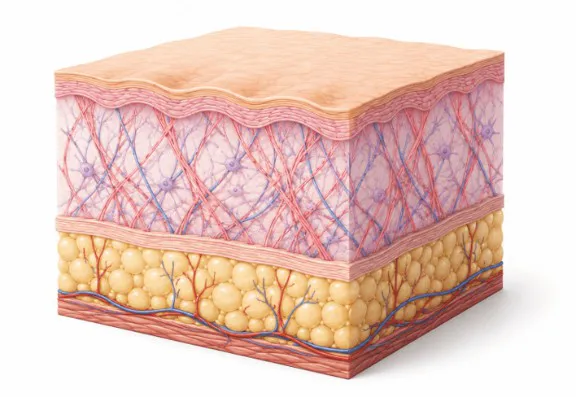
Skin relies on two key structural proteins — collagen, which provides firmness, and elastin, which allows it to stretch and return to shape. When weight is gained gradually, the skin adapts over time. When fat is lost quickly — as it typically is on GLP-1 medications — the skin doesn't always have time to adjust. The underlying support structure reduces faster than the surface can follow.
Several factors influence how much the skin recovers on its own: age (collagen production slows from the mid-thirties), how long the skin was stretched, the amount of weight lost, and individual genetics. But the most important factor specific to GLP-1 patients is speed — these medications can produce weight loss at a rate that would previously have required surgical intervention, and the skin reflects that.
It's worth being clear: this is not caused by the medication itself. GLP-1 drugs don't damage collagen or skin structure. The same changes occur after bariatric surgery or any other form of rapid fat loss. What's new is the number of people experiencing it at once.
The skin barrier problem nobody talks about
Most conversations about loose skin focus on collagen and volume. But there's another layer to this — one that directly affects how well the skin responds to treatment.
The skin barrier is the outermost layer of the skin. Its job is to retain moisture and support the skin's own repair capacity. Sustained calorie restriction and rapid fat loss place significant stress on this barrier, leaving skin drier, more reactive, and less able to regenerate effectively. In this state, the skin is poorly equipped to respond to treatment — including the collagen-stimulating treatments most clinics reach for first.
This is why skin barrier health isn't just a skincare concern. It's a clinical one. And it's one that conventional skin tightening devices don't address.
Will it improve without treatment?
Some natural retraction does happen, particularly in the first six to twelve months after weight stabilises. After that, the rate of change slows considerably. Lifestyle measures — good protein intake, hydration, daily SPF, not smoking — all support the skin's recovery, but they have a ceiling. They can't reverse established laxity on their own.
The window matters. Patients who support their skin proactively during and immediately after weight loss tend to need less corrective treatment later.
Why conventional skin tightening falls short for GLP-1 patients
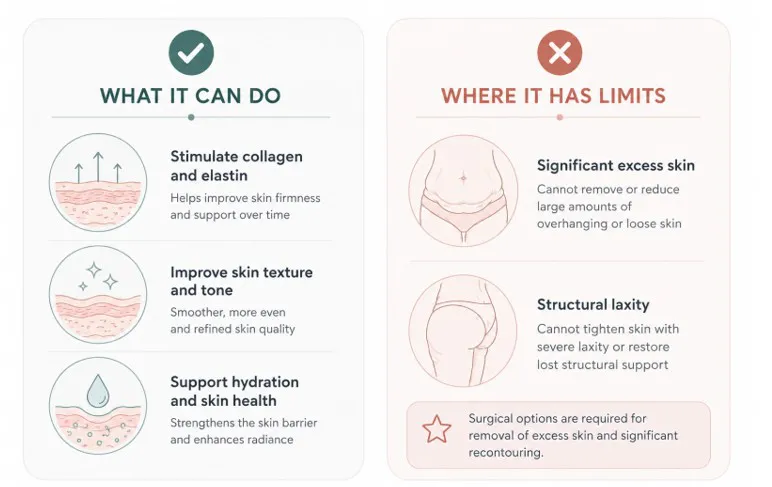
Energy-based thermal devices — radiofrequency, HIFU, RF microneedling — work by delivering controlled heat into the skin, triggering a damage-and-repair response that stimulates new collagen. They can produce good results for the right candidate. But they come with two significant limitations in this context.
First, they require the skin to be in a stable, reasonably healthy baseline state to mount an effective healing response. Applying heat-based treatment to barrier-compromised, stressed skin underperforms at best.
Second, they're not appropriate during active weight loss. Most practitioners recommend waiting three to six months after weight has stabilised before beginning thermal treatment — meaning patients spend months losing skin quality before intervention can even start.
Where LDM® Triple changes the picture
 Where LDM® Triple changes the picture
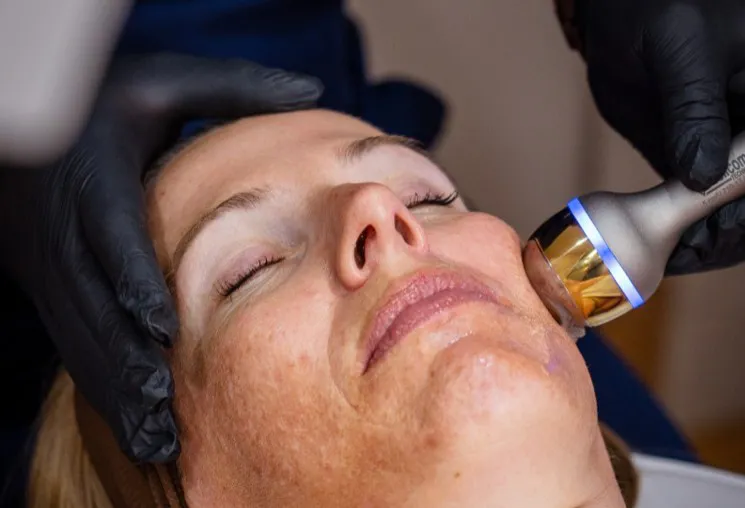
LDM® Triple takes a fundamentally different approach. Rather than generating heat, it uses alternating therapeutic ultrasound frequencies — 1MHz, 3MHz, 10MHz, and 19MHz — switching between them every one to ten milliseconds. This creates biological stimulation at multiple depths within the skin simultaneously, working with the skin's own repair mechanisms rather than overriding them.
The clinical effects are directly relevant to what GLP-1 patients need:
- Skin barrier repair — LDM® Triple restores hydration and resilience at the epidermal level, addressing the barrier compromise that weight loss creates
- Inflammation regulation — through Caveolin-1, a protein central to both skin ageing and the body's inflammatory response
- Collagen and elastin stimulation — encouraging structural remodelling in the mid and deep dermis
- No thermal damage, no downtime — making it suitable for patients at any stage of their journey
That last point is clinically significant. Because LDM® Triple causes no tissue damage, it can be used safely during active weight loss — not just after. This shifts the treatment model entirely. Rather than waiting for laxity to accumulate and then trying to correct it, LDM® Triple can support the skin through the process, keeping it in the best possible condition at every stage. Patients who begin treatment early consistently present with less established laxity by the time their weight stabilises.
It's also effective on both face and body using the same device — covering the abdomen, arms, thighs, neck, and décolletage without requiring different technologies for each area.
A different kind of treatment plan
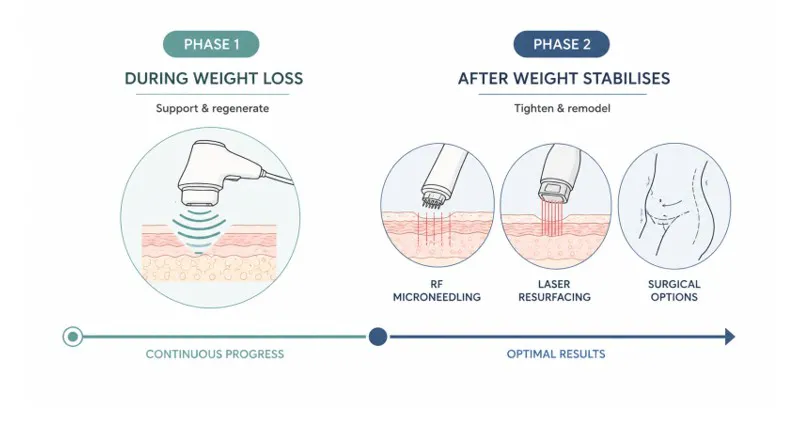
For GLP-1 patients, the most effective approach tends to follow two phases. During weight loss: LDM® Triple to maintain skin quality, repair the barrier, and build the skin's capacity to respond. After weight stabilises: assess what remains and introduce thermal or injectable treatments if needed, with the skin now in a far stronger baseline state.
 LDM
LDM
In practice, many patients who take this approach find that the degree of correction needed in the second phase is significantly reduced — or in some cases, unnecessary.
LDM® Triple is manufactured by Wellcomet GmbH in Germany and is supported by peer-reviewed clinical research, including a 2024 study in the Journal of Cosmetic Dermatology.
It is available at trained partner clinics across the UK. To find your nearest clinic, visit our clinic finder.