

There are moments in an industry when the direction becomes impossible to ignore.
Scotland has just delivered one of those moments.
In a decisive and unanimous vote, non-surgical aesthetics has been placed firmly on the path into regulated healthcare.
This is not a cautious step — it is a clear repositioning of the industry.
Treatments such as anti-wrinkle procedures, dermal fillers, chemical peels, and microneedling are now being recognised for what they truly are — clinical interventions that require structure, accountability, and oversight.
The implications are immediate.
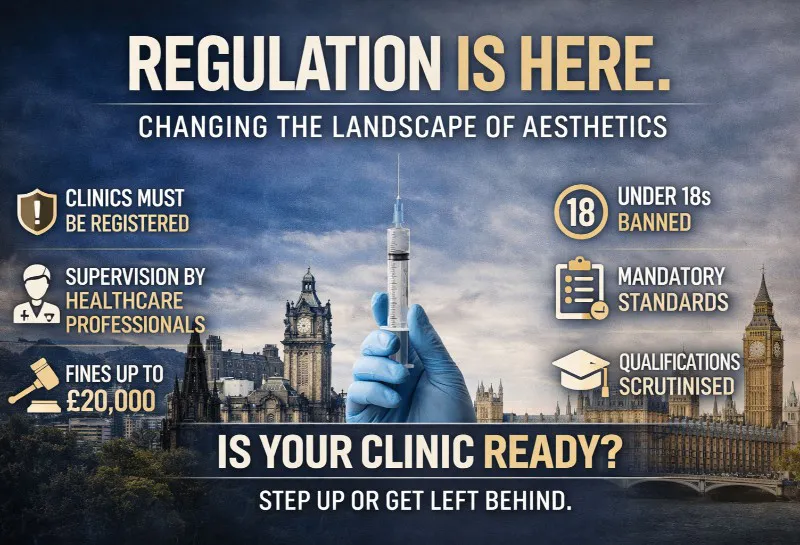
Age restrictions are now defined.
Clinics will be expected to meet regulatory standards and register appropriately.
Non-medical practitioners cannot operate without appropriate clinical supervision.
And non-compliance will carry significant financial and professional consequences.
This is about more than rules.
It is about responsibility.
And while this is happening in Scotland, it would be short-sighted to think it ends there.
England is already moving in the same direction, with formal consultation expected soon.
So the real question is not whether change is coming.
It is whether your clinic is prepared.
Because regulation does not impact everyone equally.
Clinics that already operate with strong consultation processes, clear documentation, and structured clinical governance will find themselves aligned with what is coming.
For them, this confirms they are already working at the expected level.
Others, particularly those operating without defined systems or oversight, will find the transition far more challenging.
This is where the opportunity sits.
Regulation will not just raise standards — it will reshape the landscape.
Patients will increasingly choose clinics that demonstrate safety, professionalism, and trust.
And alongside this shift, education will quietly become part of the conversation.
Not as the headline — but as the expectation behind it.
Practitioners will be asked to provide evidence of their training, how they maintain competence, and how their qualifications align with a regulated environment.
For some, this may involve progressing toward recognised standards such as Level 7, whether through full programmes, fast-track routes for experienced practitioners, or structured recognition of prior learning.
But the key point is this.
It will no longer be enough to do the treatment simply.
You will need to demonstrate that you are trained to a standard that reflects the clinical nature of the role.
This is the real shift.
Regulation is not a threat to those doing things properly.
It is the strongest advantage they could be given.
Every unsafe, unregulated provider that leaves the market creates space for those who prioritise patient care and clinical excellence.
This is a defining moment for aesthetics in the UK.
Not one of uncertainty — but one of clarity.
The clinics that succeed will be the ones that recognised early what the industry was becoming… and chose to meet it there.