

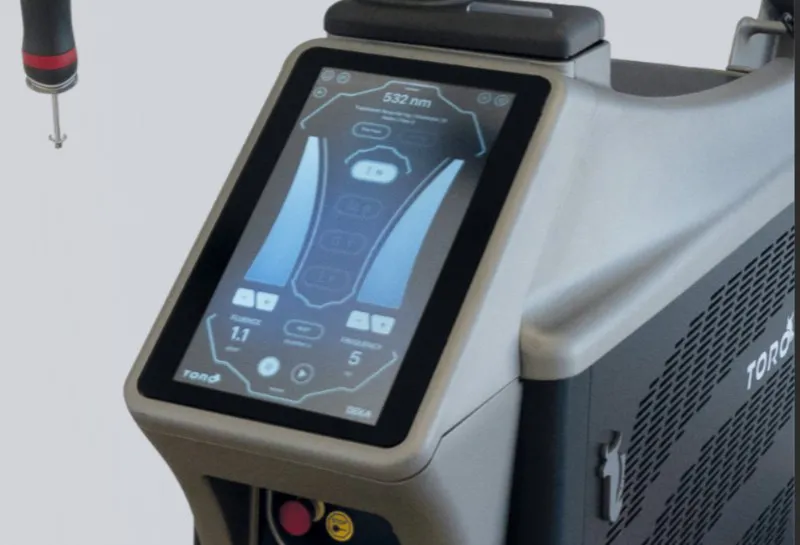


The aesthetic laser market continues to evolve, with increasing demand for devices that can treat a wider range of tattoo inks, skin types, and pigment concerns with greater precision and safety. The launch of TORO from Lynton introduces a multi-wavelength platform designed to support this shift in clinical practice.
Manufactured in Italy by DEKA and exclusively distributed in the UK by Lynton, TORO combines nanosecond and picosecond pulse delivery within a single system, alongside three wavelengths (532nm, 785nm, and 1064nm). This combination is designed to expand treatment flexibility across Fitzpatrick skin types I–VI and a broad spectrum of tattoo inks, including more challenging colours.
Multi-wavelength capability for broader clinical application
With 532nm, 785nm and 1064nm wavelengths, TORO is designed to target a broad spectrum of tattoo ink – including challenging colours such as green and blue. These pigments are typically difficult to remove, but the 785nm Titanium: Sapphire wavelength enables more effective clearance, even in stubborn or multi-coloured tattoos.
This allows practitioners to address different ink depths and compositions more precisely, supporting more tailored treatment planning across diverse tattoo cases.
Dual pulse technology: nanosecond and picosecond delivery
A key feature of the system is its ability to deliver both nanosecond and picosecond pulses within the same platform.
Dr Samantha Hills, Clinical Director at Lynton adds: “At Lynton, we’re always driven by what really matters to practitioners, results, safety and confidence. TORO embodies all three. By combining pico and nano pulse technologies in one platform, clinics can now
deliver powerful pigment, tattoo and rejuvenation treatments across all skin types. It’s designed for those who want precision without compromise – and support from a team that truly cares.”
Nanosecond pulses deliver higher energy for breaking down larger pigment particles, making them suitable for dense pigmentation and tattoo removal.
Picosecond pulses create an ultra-short photoacoustic effect, where light energy is converted into acoustic waves to fragment finer pigment with reduced thermal impact. This mechanism may help reduce the risk of post-inflammatory hyperpigmentation (PIH), particularly in more sensitive or darker skin types.
Together, these modes are intended to support greater treatment flexibility, with potential benefits in clearance efficiency, safety profile, and overall skin quality outcomes.
Beyond tattoo removal: wider treatment applications
While tattoo removal is a primary application, TORO also supports additional indications including skin rejuvenation, acne scarring, and carbon peel protocols.
These treatments are delivered with minimal downtime and without consumable costs, which may support operational efficiency in clinic settings.
Designed with clinical workflow in mind
As with other systems from Lynton and DEKA, TORO has been developed with usability and clinical workflow considerations. Features include magnetically connected handpieces, a touchscreen interface, and a consumables-free operating model.
The system is positioned as a flexible platform for pigment and skin-based treatments, designed to support clinics offering both tattoo removal and broader aesthetic laser services.
Summary
TORO represents a new multi-wavelength approach to tattoo removal and pigment management, combining nanosecond and picosecond technology within a single platform. Its expanded wavelength range and dual-pulse capability are intended to provide clinics with greater flexibility when treating a wide range of inks, skin types, and dermatological concerns.