

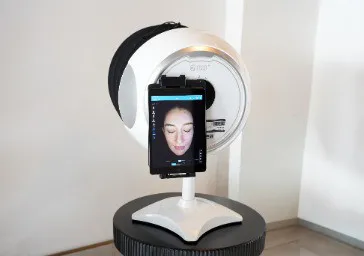
Skin analysis technology is now common in aesthetic and advanced skincare clinics, but it is often poorly explained. Devices such as the MEICET MC10 are sometimes presented as highly accurate scanners or near-diagnostic tools, which can make the process feel more definitive than it really is. For many people, this creates uncertainty about what the images mean, how reliable they are, and how much weight they should carry in treatment decisions.
A clear understanding matters because skin analysis sits at the intersection of technology, professional judgement, and personal choice. Used responsibly, imaging can support clearer conversations and help visualise certain skin characteristics. Used without proper explanation, it can lead to confusion, unnecessary concern, or misplaced expectations. Knowing the difference helps you stay in control of your skin decisions.
This guide explains how the MEICET MC10 works, what types of information it is designed to display, and how it fits into a well-conducted consultation. It also covers accuracy, limitations, data protection, and how to assess whether a clinic is using skin analysis appropriately, so you can decide calmly and confidently what role, if any, it should play for you.
The first step is understanding what the device is designed to do and what it is not.
Your MEICET MC10 Skin Analysis Device Questions
Real Questions from Real People - Answered
Straightforward answers to the questions people like you are asking right now about MEICET MC10 Skin Analysis Device.

Be the first to ask a MEICET MC10 Skin Analysis Device question.
Click here to ask your own question.
Find A Verified Clinic
Trusted MEICET MC10 Skin Analysis Device Experts, Local to You
Easily connect with qualified, verified professionals for safe, reliable treatment.

To find a MEICET MC10 Skin Analysis Device clinic near you, please click here.
How Does The Meicet MC10 Work?
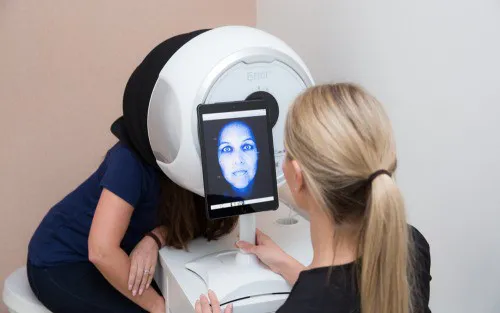
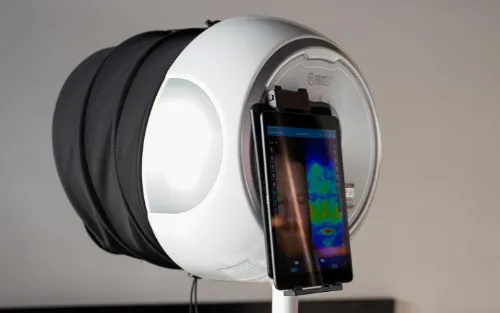
The MEICET MC10 works by capturing a series of standardised facial images under controlled conditions, then analysing those images using dedicated software.
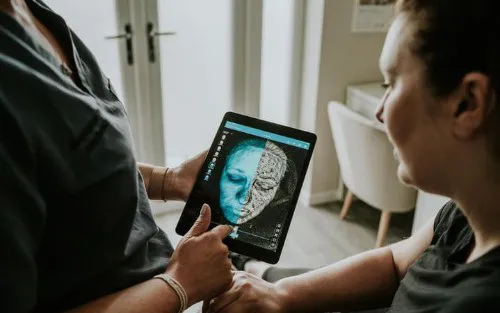
The aim is to visualise different skin features consistently, so they can be discussed clearly during a consultation.
Standardised facial photography process
During image capture, the client positions their face using fixed guides to ensure consistent distance and alignment. This standardisation helps reduce variation between sessions and supports more meaningful comparisons over time.
Multi-spectral imaging explained
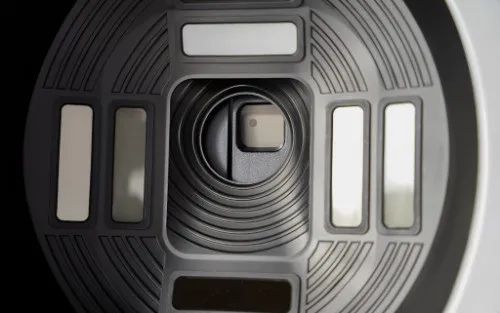
The device captures images using several lighting modes, including standard visible light, polarised light, and UV light. Each lighting condition highlights different skin characteristics, such as surface texture, redness patterns, pigmentation changes, or UV-related markers.
Software analysis and visual outputs
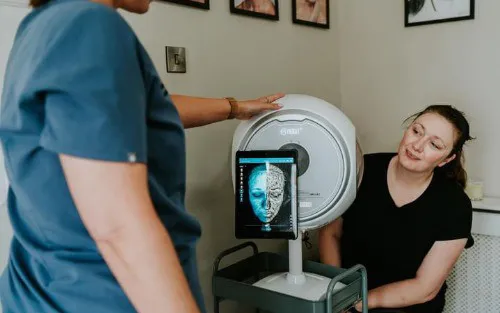
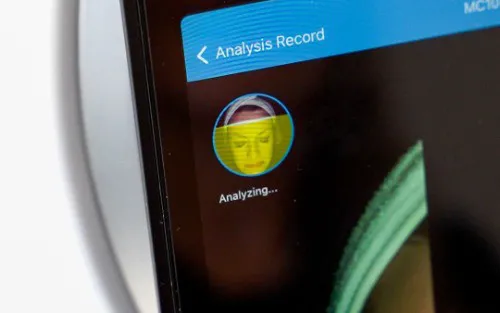
Once images are captured, the software processes them into visual maps and overlays. These outputs are designed to highlight areas of contrast or variation rather than provide measurements or diagnoses.
The importance of practitioner interpretation
The images do not explain themselves. Accurate interpretation depends on the practitioner’s training, clinical knowledge, and understanding of the client’s skin history. Without this context, images can be misunderstood or over-interpreted.
What Skin ConcernsCan The MC10 Analyse?
The MEICET MC10 is designed to visualise certain skin characteristics that are commonly discussed in aesthetic consultations.
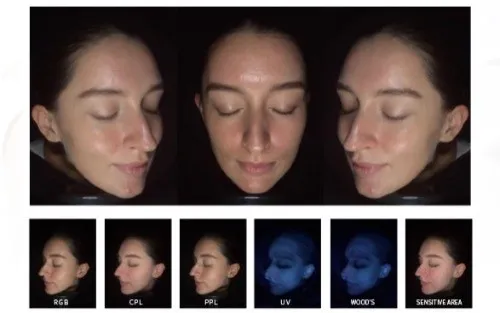
These visual outputs can support clearer explanations, but they should always be interpreted alongside professional assessment.
Pigmentation and uneven tone indicators
Multi-spectral imaging can highlight areas of uneven pigmentation, including sun-related changes that may not be obvious under normal lighting. This can be useful when discussing pigmentation patterns rather than isolated marks.
Pores, texture, and fine lines
The images can highlight visible pore distribution, surface texture, and fine lines. These outputs help frame conversations about skin quality and ageing indicators, rather than acting as a measure of severity.
Redness and sensitivity patterns
Certain lighting modes can make vascular or redness patterns more visible. This may support discussions around sensitivity or reactive skin, but it does not confirm underlying causes.
UV-related changes and acne markers
UV-based imaging can reveal areas of past sun exposure and highlight markers associated with congestion or acne-related activity. These findings are observational and require careful explanation to avoid misinterpretation.
Understanding the limits of imaging
Not all skin concerns can be accurately shown through imaging alone. Hormonal influences, inflammatory conditions, and medical skin disorders cannot be diagnosed or ruled out using the MC10.
Who Is TheMeicet MC10 Suitable For?
The MEICET MC10 is most useful in settings where skin analysis is part of a structured, professional consultation. Its value depends less on the device itself and more on how it is used and explained.
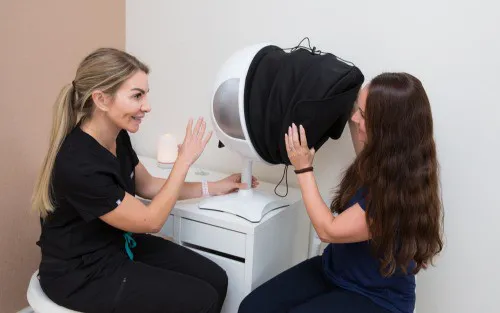
Aesthetic and advanced skin clinics
Clinics offering non-surgical aesthetic treatments or advanced skincare often use the MC10 to support consultation discussions. It can help visualise concerns that clients may struggle to describe or fully understand.
Medical-led and dermatology-adjacent practices
In medical or medically supervised environments, the MC10 may be used as an educational aid. It does not replace clinical assessment, but it can support clearer conversations when reviewing skin appearance alongside medical history.
Clinics focused on consultation quality
Practices that prioritise detailed consultations, informed consent, and long-term skin planning may find the MC10 helpful. Visual context can improve understanding when used carefully and without over-interpretation.
Clients who value visual explanations
Some clients find it easier to engage with their skin concerns when they can see visual patterns rather than rely on verbal descriptions alone. For these individuals, imaging can make consultations feel clearer and more structured.
Situations where it may not add value
The MC10 may be less useful for very straightforward concerns, limited treatment plans, or when results are unlikely to influence decision-making. It is not essential for every consultation or every client.
What Solutions Or Treatments Can It Support?
The MEICET MC10 is used to support conversations about possible skin care approaches and professional treatments.
It does not prescribe treatments or predict outcomes, and its role remains explanatory rather than directive.
Supporting treatment planning discussions
Images from the MC10 can help structure discussions around potential treatment pathways. Practitioners may use them to explain why certain concerns are being prioritised and how different options might be approached over time.
Skincare and professional treatment pathways
The visual outputs can support conversations about at-home skincare, in-clinic treatments, or combined approaches. This is particularly useful when explaining why consistency, skin barrier health, or sun protection may matter in the broader plan.
Monitoring progress over time
When used consistently, the MC10 can help track visible changes across multiple consultations. This can support realistic conversations about gradual improvement rather than short-term change.
Using images to explain preventative care
Imaging may highlight early or cumulative changes linked to sun exposure or skin ageing. These visuals can help explain preventative strategies without framing them as urgent or corrective.
Avoiding outcome guarantees
Any treatment discussion supported by imaging should remain cautious. The MC10 does not guarantee results, predict treatment response, or confirm suitability on its own.
Choosing A Provider Or PractitionerUsing Mc10
The value of a skin analysis depends heavily on who is using the device and how the results are explained. Choosing the right provider is as important as the technology itself.
The importance of training and experience
The MC10 should be used by practitioners who are trained in both skin assessment and the limitations of imaging technology. Experience allows them to interpret results within the context of skin history, lifestyle factors, and clinical presentation.
How results should be explained to clients
A responsible practitioner will explain what the images suggest, what they cannot confirm, and where uncertainty exists. Clear language and balanced explanation help prevent unnecessary concern or unrealistic expectations.
Red flags in over-interpretation
Be cautious if imaging results are presented as diagnoses, definitive proof of damage, or guarantees of treatment outcomes. Overstating findings undermines informed consent and can lead to poor decision-making.
Questions clients can ask during a consultation
Clients may wish to ask how the images will be used, whether results will influence treatment planning, and how progress is typically reviewed. These questions support transparency and shared understanding.
Alignment with UK advertising and professional standards
Any use of imaging should align with UK advertising guidance and professional standards. Claims must remain factual, balanced, and free from implied medical or cosmetic guarantees.
What To Expect From The Skin Analysis Process
A skin analysis appointment using the MEICET MC10 is usually straightforward and non-invasive.
Understanding what typically happens can help set realistic expectations and reduce uncertainty before attending.
Appointment flow and image capture
At the start of the appointment, the practitioner will explain the process and position you for image capture. The device takes a series of facial photographs under controlled lighting conditions, usually within a few minutes.
Time involved and comfort considerations
The imaging process itself is brief and does not involve physical contact with the skin. Most appointments include additional time to review images and discuss findings, rather than focusing solely on image capture.
Reviewing images and findings
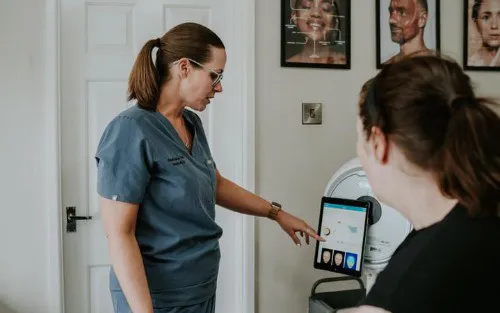
After the images are taken, the practitioner will review them with you. They should explain what each view highlights, why certain areas are being discussed, and how this information fits into the wider consultation.
Reports, records, and follow-up
Some clinics provide a summary report or store images for future comparison. You should be told how your images are kept, whether they will be reused, and how follow-up reviews are handled.
How results are typically used
Results are usually used to support discussion rather than make immediate decisions. In many cases, they form part of an ongoing conversation about skin care, monitoring, or potential treatment planning.
CostConsiderations
The cost of a skin analysis using the MEICET MC10 can vary between clinics.
Pricing is influenced by how the analysis is positioned within the consultation and the level of professional input provided.
Typical pricing context in clinics
Some clinics include skin analysis as part of a paid consultation, while others offer it as an optional add-on. Fees may reflect the time taken to capture images, interpret results, and discuss findings in detail.
What the cost usually reflects
The value is not in the images alone, but in the practitioner’s expertise and explanation. A higher fee may indicate a more comprehensive consultation rather than a more advanced scan.
When it may represent good value
Skin analysis can be worthwhile when it meaningfully improves understanding, supports long-term planning, or helps track changes over time. Its usefulness depends on how well it informs decisions rather than its standalone cost.
When cost may outweigh benefit
For very simple concerns or one-off treatments, a skin analysis may add limited insight. In these cases, a standard consultation may be sufficient.
Side Effects, Risks, And LimitationsOf The MC10 skin
The MEICET MC10 skin analysis is non-invasive and does not involve treatment. However, it is still important to understand its limitations and how risks can arise through interpretation rather than use.
Non-invasive nature and safety profile
The MC10 uses photographic imaging and controlled lighting. It does not break the skin, apply energy, or cause physical side effects. For most people, the process is comfortable and low risk.
No diagnosis or medical certainty
Skin analysis imaging cannot diagnose conditions, confirm disease, or rule out medical concerns. Any suggestion of diagnosis should come from a qualified medical professional, not from the imaging itself.
Variability between sessions
Results can vary depending on lighting conditions, positioning, skin preparation, and environmental factors. This means images should be compared cautiously and only when captured under consistent conditions.
Risk of misinterpretation without guidance
The main risk lies in how images are explained. Without proper context, visual outputs can be misunderstood, leading to unnecessary concern or unrealistic expectations.
Data handling and consent considerations
Facial images are personal data. Clinics should explain how images are stored, who can access them, and how consent is obtained before images are captured.
How Accurate Is Skin Analysis Imaging?
The accuracy of skin analysis imaging needs careful explanation.
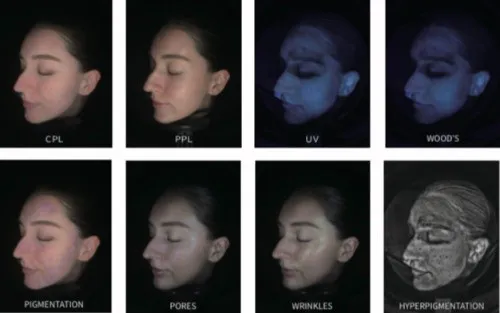
Devices like the MEICET MC10 are designed to support visual understanding, not to deliver precise measurements or clinical certainty.
What “accuracy” means in skin imaging
In this context, accuracy refers to consistency and clarity rather than exact measurement. The MC10 highlights visual patterns and contrasts that help guide discussion, not definitive data points about skin health.
Factors that influence results
Image quality can be affected by lighting, positioning, skin preparation, and the operator’s technique. Even small variations can change how features appear, which is why results should be interpreted cautiously.
Visualisation versus measurement
The MC10 visualises differences in tone, texture, or surface features, but it does not measure skin thickness, cell activity, or disease processes. Understanding this distinction helps prevent over-reliance on images.
Managing expectations in consultations
Practitioners should explain that images are a snapshot in time. They support conversation rather than confirm progression, severity, or treatment response on their own.
Why consistency matters more than precision
When imaging is used to track change, consistency in how images are taken is more important than absolute precision. Comparable conditions allow more meaningful visual comparison across appointments.
How The Meicet MC10 ComparesTo Other Skin Analysis Devices
Skin analysis devices vary widely in how they capture images, process data, and present results.
Understanding these differences can help place the MEICET MC10 in context, rather than viewing it as better or worse by default.
High-level comparison with similar systems
Like many professional skin analysers, the MC10 uses multi-spectral imaging and software-based visual outputs. Other devices may prioritise fewer lighting modes, automated scoring, or different report formats. These differences affect how results are presented, not whether they are clinically diagnostic.
Strengths and trade-offs
The MC10’s strength lies in visual explanation and consultation support. Some systems focus more heavily on numerical scores or automated recommendations, which may feel more definitive but can also increase the risk of over-interpretation.
Differences in imaging, software, and reporting
Devices differ in camera resolution, lighting configurations, and how results are displayed. Software design also varies, with some platforms offering more customisation and others favouring standardised reports. None of these features replaces professional judgement.
Suitability for different clinic models
Clinics that prioritise detailed consultations and client education may favour devices that support visual discussion. Practices focused on speed or standardised pathways may choose different systems that align with their workflow.
Why no single device suit every practice
There is no universal best option in skin analysis technology. Each device reflects trade-offs between depth, simplicity, automation, and practitioner input.
Data Protection,Consent, And Client Privacy
Skin analysis involves capturing facial images, which are classed as personal data. How this information is handled should be clear, transparent, and compliant with UK data protection expectations.
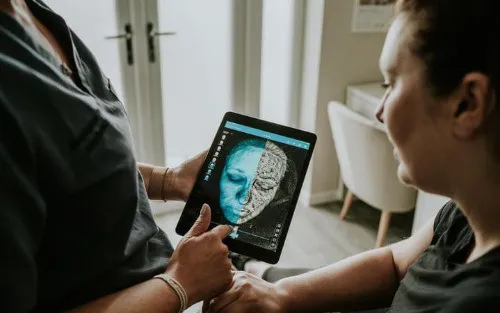
Facial imaging and personal data
Facial photographs used for skin analysis can identify an individual. Clinics have a responsibility to treat these images with the same care as other personal or health-related records.
UK GDPR relevance
In the UK, skin analysis images are subject to data protection regulations. Clinics should have a lawful basis for collecting and storing them, explain how long they are retained, and outline who has access to them.
Consent best practice for skin photography
Consent should be explicit and informed. Clients should understand why images are being taken, how they will be used, and whether they will be used again for comparison or education.
Report storage and sharing
Some clinics store reports digitally or share them with clients. You should be told whether images are stored locally, in the cloud, or within third-party software, and whether they can be deleted on request.
Building trust through transparency
Clear explanations about data handling help build trust. A reputable clinic will answer questions about privacy without defensiveness or ambiguity.
Using Skin AnalysisTo Track Progress Over Time
Skin analysis imaging can support longer-term monitoring when applied consistently and explained carefully.
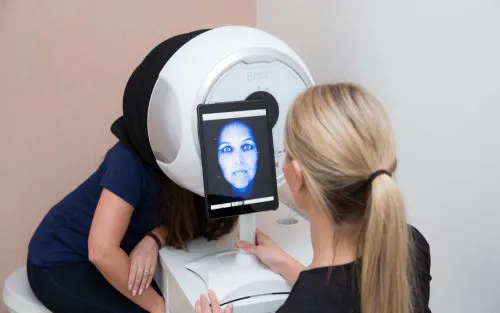
Its role is to provide visual reference points, not to prove results or predict outcomes.
Baseline versus follow-up imaging
An initial skin analysis is often used as a baseline. Follow-up images can then be compared against this reference to help visualise changes in tone, texture, or visible surface features over time.
What changes can realistically be monitored
Imaging may highlight gradual changes in areas such as pigmentation patterns, redness visibility, or overall skin appearance. These observations support discussion rather than confirmation of treatment effectiveness.
Avoiding misleading before-and-after claims
Skin analysis images should not be presented as before-and-after proof. Differences in lighting, positioning, or skin condition on the day can influence appearance and must be acknowledged.
When progress tracking is most useful
Tracking can be helpful in longer-term skin care plans, preventative approaches, or when changes are expected to be subtle and gradual. It is less useful for short-term or one-off treatments.
Communicating gradual change clearly
Practitioners should frame progress in realistic terms, explaining that skin changes often occur slowly and vary between individuals.
MEICET MC10Conclusion
Skin analysis devices such as the MEICET MC10 can be useful when they are understood for what they are: supportive tools that add visual context to a professional consultation.
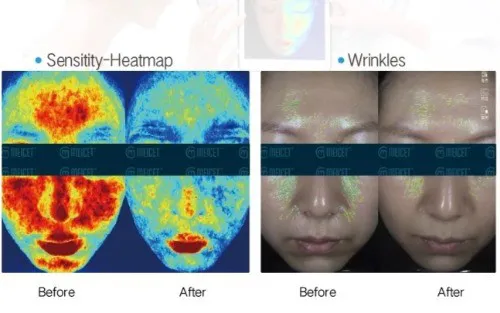
They do not diagnose skin conditions, predict outcomes, or replace clinical judgement. Their value lies in helping practitioners explain visible patterns clearly and helping clients understand their skin in a more structured way.
What matters most is not the technology itself, but how it is used. Consistent image capture, careful interpretation, and transparent explanation are essential if skin analysis is to support informed decision-making rather than create confusion or unnecessary concern. Used responsibly, imaging can sit comfortably alongside skin history, professional assessment, and individual priorities.
If you are considering a skin analysis, it is reasonable to take time to reflect on whether it adds meaningful insight for you. Asking clear questions, understanding the limits of what imaging can show, and discussing findings with a qualified practitioner can help you decide what role, if any, skin analysis should play in your wider skincare or aesthetic planning.
MEICET MC10 Skin Analysis Device Quick FAQs
Clear, Concise Answers to Common Queries
A simple, no-fluff roundup of frequent MEICET MC10 Skin Analysis Device questions to help you get the facts fast.

Is a MEICET MC10 skin analysis suitable for sensitive skin?
Yes, the imaging process itself is non-invasive and does not involve contact with the skin. Sensitivity relates more to how results are interpreted, so it is important that a practitioner carefully explain findings and avoid overstating redness or reactivity.
Do I need to prepare my skin before a skin analysis appointment?
Clinics may ask you to arrive with clean skin and no makeup. This helps ensure images reflect your natural skin appearance and reduces variation caused by products or surface residue.
Can skin analysis results change depending on the time of day?
They can. Factors such as hydration, recent exercise, sun exposure, or skincare use can influence how skin appears. This is why results should be viewed as a snapshot rather than a fixed assessment.
Is skin analysis useful if I am not planning treatment?
It can be. Some people use skin analysis to better understand their skin or guide skincare choices, without any intention of having in-clinic treatments.
Can the MC10 detect skin cancer or medical conditions?
No. The device is not designed to detect skin cancer or diagnose medical conditions. Any concerning findings should be assessed by a qualified medical professional.
How often should skin analysis be repeated?
There is no standard schedule. Repeat analysis is usually considered for longer-term monitoring, rather than for frequent or short-term review.
Are results affected by skincare products I already use?
Yes. Active ingredients, recent treatments, or temporary irritation can influence how skin appears on imaging. Practitioners should take this into account when explaining results.
Is skin analysis recommended during pregnancy?
The imaging itself is generally considered low risk, but pregnancy can affect skin appearance. Results should be interpreted cautiously, and treatment discussions should follow appropriate medical guidance.
Can different clinics interpret the same images differently?
They can. Interpretation depends on practitioner training and experience, which is why clear explanation and professional context matter.
Does skin analysis replace a face-to-face consultation?
No. Skin analysis is intended to support a consultation, not replace discussion, examination, or clinical judgement.
Will I always receive a printed or digital report?
This varies by clinic. Some provide reports, while others use images only during the consultation. You should be told what to expect beforehand.
Can skin analysis be used for all skin tones?
Most devices are designed to work across a range of skin tones, but certain features may appear differently. Practitioners should explain any limitations clearly.
Is skin analysis necessary before every aesthetic treatment?
No. Many treatments can be planned safely without imaging. Skin analysis is optional and should only be used when it adds meaningful understanding.
Can I decline skin analysis during a consultation?
Yes. Skin analysis is not mandatory. A clinic should respect your preference and explain alternative ways they assess skin concerns.