

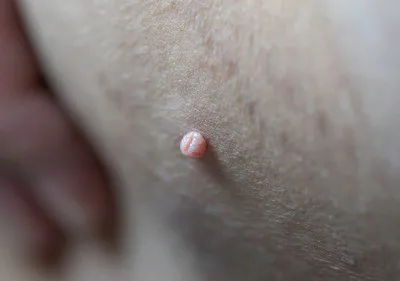
Skin tags are one of the most common reasons people look up skin changes, often because a small new growth can feel unexpectedly alarming. They are usually harmless, but they can be irritating, catch on clothing, or sit in a noticeable area like the neck or eyelids. Online information can also be confusing, with mixed messages about causes, risk, and whether home removal is safe.
Careful understanding matters here for two reasons. First, it helps you recognise what is typical, so you can feel reassured when a growth behaves like a skin tag. Second, it helps you spot when something does not fit the usual pattern, so you know when to seek proper assessment rather than guessing.
This guide covers what skin tags are called in medical settings, what they tend to look and feel like, and why they often appear in areas of friction. It also explains how to tell skin tags apart from other skin lesions, what changes to check, and what to expect from UK care pathways if you are considering removal. The aim is to leave you clear on what is normal, what needs a second look, and your options.
Our Preferred Partner - Jovena Fractional Plasma

Skin tag removal may be a straightforward procedure, but how the tissue is treated can make a meaningful difference to both outcomes and patient experience. That’s where fractional plasma technology on the Jovena device offers a more considered approach.
By delivering controlled plasma energy in precise micro-points, the treatment works within the upper layers of the skin to target the concern while leaving surrounding tissue largely unaffected. This supports a natural repair response, encouraging cleaner healing and more refined results over time.
For clinics, Jovena provides a versatile platform that extends beyond simple lesion removal into broader skin renewal and resurfacing treatments. For patients, it offers a precise, controlled option that aligns removal with overall skin quality - not just resolution of the concern.
What Are Skin Tags?
Skin tags are very common, non-cancerous growths that develop on the skin's surface. Medically, they are considered harmless, and for most people, they are a normal variation of adult skin rather than a sign of disease.
Simple explanation in everyday terms
Skin tags are small, soft skin growths that sit on the surface and are often attached by a narrow stalk.
- They are usually flesh-coloured or slightly darker than the surrounding skin.
- They tend to feel smooth and flexible rather than firm.
- Most skin tags cause no symptoms, although they can catch on clothing or jewellery depending on their location.
A key point for reassurance is that skin tags are benign. They do not turn into skin cancer and are not infectious.
The medical term and what it means
In medical settings, skin tags are called acrochordons.
- This term simply refers to a benign skin growth.
- It does not indicate severity or risk, and it is not linked to cancer.
- Clinicians use this term for accuracy and consistency in diagnosis and records.
Hearing a medical name can sometimes sound concerning, but in this case, it reflects classification rather than danger.
Skin tags are a routine and well-understood skin finding, particularly in adults. Knowing that they are benign helps frame later decisions about whether to monitor or remove them.
What Do Skin Tags Look And Feel Like?
Skin tags have a recognisable appearance, which is one of the reasons they are usually straightforward to identify in a clinical setting. Understanding what is typical can help reduce unnecessary worry when a new growth appears.
Typical size, colour, and texture
Most skin tags are small and soft, although their size can vary.
- They often measure a few millimetres but can gradually increase in size over time.
- The colour is commonly similar to the surrounding skin, though some appear slightly darker due to friction or blood supply.
- When touched, skin tags usually feel smooth and pliable rather than hard or scaly.
People sometimes worry that a skin tag will darken or become more noticeable. In many cases, this relates to irritation or twisting at the base rather than a serious change, although any sudden or marked change should be checked.
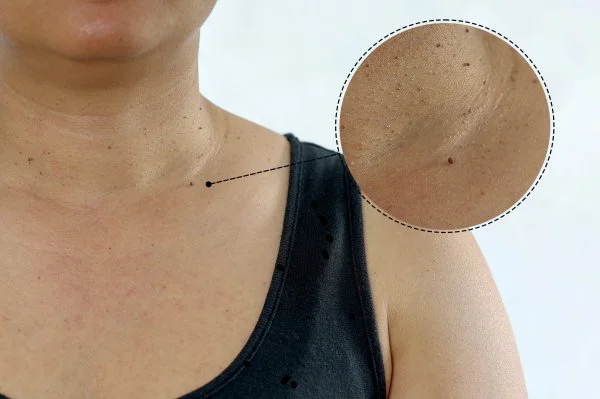
Common areas of the body
Skin tags tend to develop in areas where skin naturally folds or rubs together.
- The neck and underarms are among the most common sites.
- Eyelids, under the breasts, the groin, and inner thighs are also frequent locations.
- They can appear as a single growth or in small clusters.
These patterns reflect mechanical friction rather than hygiene or lifestyle habits, which is an important point of reassurance for many people.
The appearance of skin tags is usually consistent and predictable, which helps clinicians distinguish them from other skin lesions. Location and texture often provide valuable clues during assessment.
How Common Are Skin Tags?
Skin tags are extremely common, particularly in adulthood. For many people, developing one or more skin tags is a normal part of skin ageing rather than an unusual medical issue.
Who tends to get skin tags?
Skin tags can affect adults of all backgrounds and skin types.
- Studies suggest that around half of adults will develop at least one skin tag during their lifetime.
- They occur in both men and women at similar frequencies.
- They become more common from mid-adulthood onwards, particularly from the forties and fifties.
This prevalence often reassures people that skin tags are not rare or concerning.
Skin tags across different life stages
Certain life stages and physical changes are associated with a higher likelihood of developing skin tags.
- Hormonal changes, such as those seen during pregnancy or menopause, can coincide with new skin tags.
- Weight changes may increase skin friction, which can contribute to their development.
- Some people notice a gradual increase in the number over time rather than a single isolated growth.
It is also worth noting that skin tags do not usually disappear on their own once they have formed, although they may remain stable for years.
Skin tags are a very common feature of adult skin, particularly as the body changes with age and hormones. Their frequency alone is not a sign of poor health.
Why Do Skin Tags Develop?
Skin tags develop for a combination of mechanical and biological reasons. In most cases, there is no single cause, and their appearance does not reflect anything someone has done wrong.
The role of friction and skin folds
Friction is one of the most widely accepted factors in skin tag development.
- Skin tags commonly form where skin rubs against skin or clothing.
- Areas such as the neck, underarms, groin, and under the breasts are particularly prone.
- Repeated low-level irritation over time appears to encourage small areas of skin to grow outward.
This helps explain why skin tags often appear gradually and why they cluster in specific locations.
Hormones, metabolism, and genetics
In addition to friction, internal factors can play a role.
- Hormonal changes are thought to influence skin growth, which is why skin tags may appear during pregnancy or midlife hormonal shifts.
- Research has identified an association between multiple skin tags and insulin resistance, type 2 diabetes, and metabolic syndrome. This is an association rather than a direct cause, and skin tags alone do not diagnose an underlying condition.
- Some people appear genetically predisposed, noticing that close family members also develop skin tags.
For most individuals, these factors overlap rather than act in isolation.
Skin tags usually develop due to a combination of friction, hormonal influences, and individual susceptibility. Their presence is common and typically benign, even when several factors are involved.
Skin Tags Vs Other Skin Growths
Skin tags are often recognised by their appearance and texture, but it is common for people to wonder whether a new growth could be something else. Clear comparison helps reduce uncertainty and supports timely assessment when needed.
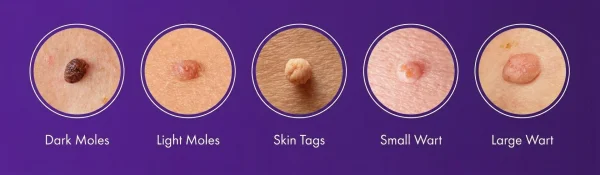
Skin tags vs moles
Skin tags and moles differ in both structure and behaviour.
- Skin tags are usually soft, flexible, and attached by a narrow stalk.
- Moles tend to be flat or slightly raised and are part of the skin rather than hanging from it.
- Moles are often more evenly pigmented and may be brown, black, or pink, whereas skin tags are usually flesh-toned.
A longstanding, unchanged mole is often harmless, but moles that change in size, shape, or colour should always be reviewed.
Skin tags vs warts and other lesions
Other benign skin growths can sometimes be mistaken for skin tags.
- Warts are caused by a viral infection and often feel rough or grainy rather than smooth.
- Seborrhoeic keratoses are surface growths that look waxy or scaly and appear stuck onto the skin.
- Skin tags do not spread, are not contagious, and do not have a rough surface.
If a lesion bleeds easily, becomes painful, or looks very different from surrounding skin, professional assessment is advisable rather than self-diagnosis.
Most skin tags can be distinguished from other common skin growths by their softness, shape, and location. When features overlap or uncertainty remains, a clinical opinion provides clarity and reassurance.
When Should A Skin Tag Be Checked?
Most skin tags do not require medical assessment. However, there are situations where a professional opinion is sensible, particularly if a growth does not follow the usual pattern.
Normal features vs warning signs
Typical skin tags remain stable over time and cause little more than minor irritation.
- A skin tag that stays the same size, colour, and shape is usually not concerning.
- Mild catching or rubbing is common, especially in frictional areas.
Certain changes should prompt a review:
- Rapid growth, especially over weeks rather than years.
- Persistent pain, bleeding without obvious injury, or ulceration.
- Marked colour change, particularly to very dark, black, or irregular pigmentation.
These signs do not automatically indicate a serious condition, but they do warrant assessment to rule out other conditions.
Who should assess skin tags
Assessment can be carried out by an appropriate healthcare professional.
- A GP can review skin lesions and advise whether referral or monitoring is needed.
- A dermatologist provides a specialist assessment when the diagnosis is uncertain.
- Trained medical aesthetic practitioners may assess and treat skin tags, provided the diagnosis is clear and within their scope of practice.
The key requirement is accurate identification before any treatment is considered.
While most skin tags are harmless and need no action, changes in appearance or symptoms are a reasonable reason to seek advice. Assessment is about reassurance and accuracy, not automatic treatment.
Do Skin Tags Need To Be Treated?
In most cases, skin tags do not require medical treatment. Decisions about removal are usually based on comfort, practicality, or personal preference rather than health risk.
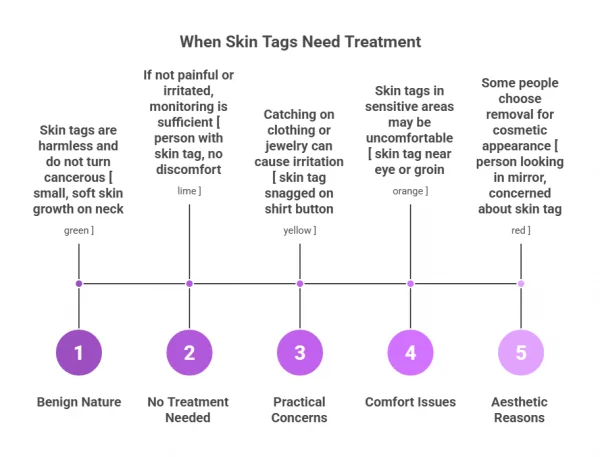
When no treatment is needed
Leaving a skin tag alone is often the most appropriate option.
- Skin tags are benign and do not become cancerous.
- If they are not painful, bleeding, or repeatedly irritated, monitoring is sufficient.
- Many people live with skin tags for years without any problems.
This approach aligns with UK clinical guidance, which does not routinely recommend removal unless there is a clear reason.
Reasons people choose removal
Some people decide to have skin tags removed for practical or quality-of-life reasons.
- Repeated catching on clothing or jewellery can cause irritation or minor bleeding.
- Skin tags in sensitive areas, such as the eyelids or groin, may be uncomfortable.
- Some people feel self-conscious about visible skin tags, particularly on the neck or face.
These reasons are valid, but it is still important that removal is approached as an informed choice rather than a necessity.
Skin tags rarely require treatment, and leaving them alone is medically sound for most people. When removal is considered, it should be based on comfort, location, and personal preference, supported by proper assessment.
Your Next Steps
Once it is clear that skin tags are benign and usually optional to treat, the focus shifts to practical decision-making. This includes understanding care pathways in the UK and knowing when a professional conversation may be helpful.
Understanding NHS and private care pathways
In the UK, skin tag removal is usually classed as cosmetic.
- The NHS does not typically fund removal unless there is a clear medical reason, such as repeated bleeding or diagnostic uncertainty.
- Many people who choose removal do so privately, either through a GP practice, dermatology clinic, or a regulated medical aesthetics provider.
- Private treatment should always begin with confirmation of diagnosis rather than immediate removal.
Understanding this distinction helps set realistic expectations and avoid unnecessary referrals or delays.
Preparing for a professional conversation
If you are considering assessment or removal, preparation supports a more useful consultation.
- Note any recent changes in size, colour, or symptoms.
- Consider whether the skin tag causes physical irritation or practical problems.
- Ask about the practitioner’s training and experience, and the method they recommend for your skin type and the area involved.
This approach keeps the discussion focused on safety, suitability, and informed choice rather than outcomes.
For most people, skin tags are harmless and can be monitored. When advice or treatment is considered, understanding the care pathway and asking the right questions supports calm, confident decision-making.
Conclusion
Skin tags are a very common, benign skin finding, and in most cases, they are more of a practical or cosmetic concern than a medical one. Understanding their typical appearance and where they tend to appear can make it easier to recognise what is normal and avoid unnecessary worry when a new growth appears in a high-friction area, such as the neck or underarms.
The most useful point to hold onto is this: skin tags do not usually need treatment. It is reasonable to leave them alone if they are not causing irritation, and equally reasonable to consider removal if they catch, bleed, or sit in a sensitive location. The key is making that choice from a place of clarity rather than uncertainty.
If anything about a skin growth feels atypical (rapid change, persistent bleeding, pain, or irregular colour), it is worth having it assessed. Otherwise, taking your time, reading from trusted sources, and discussing options with a qualified professional can help you decide what, if anything, you would like to do next.
Your Skin Tag Removal Questions
Real Questions from Real People — Answered
Straightforward answers to the questions people like you are asking right now about Skin Tag Removal.

Be the first to ask a Skin Tag Removal question.
Click here to ask your own question.
Find A Verified Clinic
Trusted Skin Tag Removal Experts, Local to You
Easily connect with qualified, verified professionals for safe, reliable treatment.

Renew Medi Clinic
Renew Medi Clinic is a medical-led aesthetic and regenerative clinic in Brighton, offering personalised treatments focused on natural results, skin health and long-term wellbeing.

Dr Vahe Clinic
Dr Vahe Clinic is a doctor-led medical, surgical, aesthetic and longevity clinic in Chelsea, London, providing personalised, evidence-based treatments focused on safety and natural results.
To find a Skin Tag Removal clinic near you, please click here.
Grow Your Practice with Skin Tag Removal
Whether you are already using Skin Tag Removal or considering adding it to your treatment menu, here is how to make the most of it.

Are you a practitioner? If you'd like to link your practice to Skin Tag Removal and become part of ConsultingRoom.com, you can register as a verified specialist using the information on our specialist registration page.
Once verified, your profile can feature Skin Tag Removal alongside the other treatments, conditions and products you support, helping patients searching ConsultingRoom.com find you directly.