


Skin tags are very common, benign growths that affect people of all skin tones. Despite this, information about skin tags is often presented as if skin responds in the same way for everyone. For people with skin of colour, this can leave important questions unanswered, particularly regarding healing, pigment changes, and the advisability of removal.
Much of the uncertainty arises not because skin tags are more serious on darker skin, but because melanin-rich skin can respond more visibly to inflammation, even after minor procedures. This means that issues such as temporary darkening, lightening, or uneven pigmentation are discussed more often and understandably cause concern. Without a clear explanation, these risks can feel unclear or overstated.
This guide is designed to provide balanced, practical information to help you understand how skin tags are identified, how skin of colour typically heals, and what factors influence safety and suitability if removal is considered. It also explains why technique, practitioner experience, and aftercare matter, and when it may be reasonable to leave a skin tag alone.
The aim is not to encourage treatment, but to support informed, thoughtful decision-making, based on how your skin behaves and what matters to you.
Our Preferred Partner - Jovena Fractional Plasma

Skin tag removal may be a straightforward procedure, but how the tissue is treated can make a meaningful difference to both outcomes and patient experience. That’s where fractional plasma technology on the Jovena device offers a more considered approach.
By delivering controlled plasma energy in precise micro-points, the treatment works within the upper layers of the skin to target the concern while leaving surrounding tissue largely unaffected. This supports a natural repair response, encouraging cleaner healing and more refined results over time.
For clinics, Jovena provides a versatile platform that extends beyond simple lesion removal into broader skin renewal and resurfacing treatments. For patients, it offers a precise, controlled option that aligns removal with overall skin quality - not just resolution of the concern.
Why Skin Tags And Skin Of Colour Need Specific Consideration
Skin tags are common, benign growths, but when they occur on the skin of people of colour, their assessment and management benefit from additional care. This is because melanin-rich skin can respond differently to even minor skin trauma, including simple removal procedures.
What clinicians mean by "skin of colour"
- In clinical practice, skin of colour usually refers to Fitzpatrick skin types IV to VI, which tan easily and contain higher melanin levels.
- This classification relates to how skin responds to inflammation, injury, and light exposure, rather than ethnicity alone.
- People within the same ethnic background can have very different skin responses, which is why individual assessment is important.
Why are skin tags common across all skin tones
- Skin tags, also called acrochordons, occur across all ethnicities and skin tones.
- They are benign and are not associated with skin cancer.
- Factors such as skin friction, hormonal changes, age, and metabolic health influence their development more than skin colour itself.
Skin tags do not behave differently on the skin of people of colour from a medical perspective, but the surrounding skin may heal differently after irritation or removal. Recognising this distinction early supports clearer expectations and more informed decisions.
How Skin Of Colour Heals Differently After Minor Procedures
Skin of colour often heals well, but it can be more prone to inflammation from minor procedures, including skin tag removal. Understanding these healing patterns helps explain why pigment changes are discussed more carefully for darker skin tones.
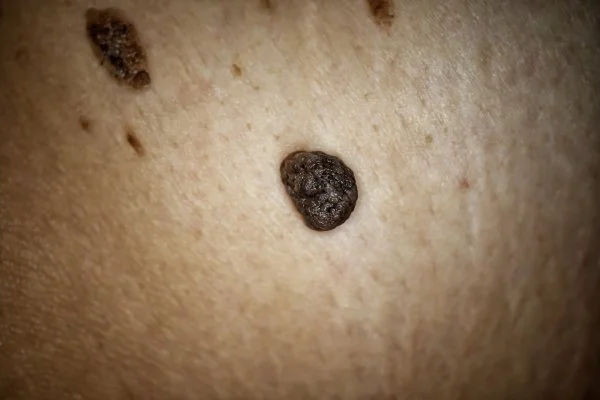
The role of melanin in healing and pigmentation changes
- Melanin-producing cells respond to inflammation, not just injury, which means even small procedures can trigger a temporary colour change.
- This response is known as post-inflammatory hyperpigmentation, in which the skin becomes darker at the site of injury.
- Hyperpigmentation is a pigment response, not scarring, and usually fades gradually over time.
Why are pigment changes more noticeable on darker skin
- Higher baseline melanin levels make colour changes more visible, even when healing is otherwise normal.
- Areas exposed to friction or sunlight are more prone to prolonged pigment changes.
- The risk is influenced by the depth of treatment, the healing time, and the aftercare, rather than by the presence of the skin tag itself.
Hypopigmentation and scarring in context
- Hypopigmentation refers to lightening of the skin and is less common but can occur if pigment-producing cells are disrupted.
- Keloid or hypertrophic scarring is uncommon after skin tag removal, but the risk is slightly higher on certain body areas and in people with a personal or family history.
- These risks can often be reduced through careful technique and conservative treatment choices.
Differences in healing relate to how melanin responds to inflammation, not to skin strength or resilience. With appropriate planning and technique, most healing changes are temporary and manageable.
Identifying Skin Tags Accurately On Skin Of Colour
Accurate identification is an essential first step before any discussion about removal. On skin of colour, some benign skin growths can appear less distinct in colour contrast, which makes careful assessment particularly important.
How skin tags typically appear on darker skin tones
- Skin tags are usually soft, smooth growths attached by a narrow stalk.
- On skin of colour, they may appear skin-toned, light brown, dark brown, or slightly grey rather than pale pink.
- They commonly develop in areas of friction, such as the neck, underarms, groin, eyelids, and under the breasts.
- Texture and movement are often more reliable indicators than colour alone.
When skin tags can resemble other benign lesions
- Some moles, seborrhoeic keratoses, and warts can appear darker or more raised on melanin-rich skin.
- Seborrhoeic keratoses may appear smoother or less distinctly textured on darker skin tones, increasing the risk of misdiagnosis.
- Viral warts are usually firmer and rougher, while moles tend to have a broader base and more consistent pigmentation.
Why professional assessment matters before removal
- Visual examination by an experienced practitioner helps confirm that a lesion is suitable for cosmetic removal.
- In some cases, dermoscopy or referral may be appropriate if a lesion lacks typical skin tag features.
- Correct diagnosis reduces the risk of unnecessary treatment and avoids inappropriate removal methods.
Skin tags themselves are similar across skin tones, but accurate identification is particularly important on skin of colour, where visual cues can be more subtle. A careful assessment supports both safety and appropriate treatment planning.
Is Skin Tag Removal Safe For Skin Of Colour?
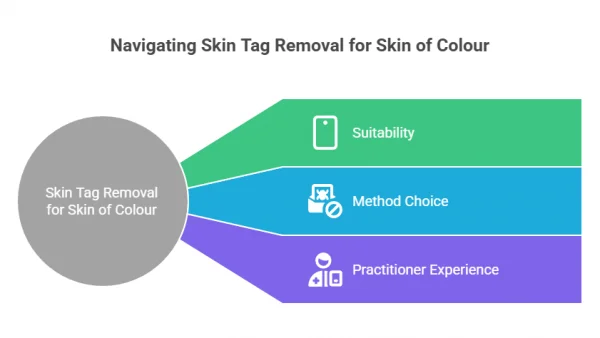
Skin tag removal can be safe for skin of colour when performed carefully and appropriately. The key considerations are suitability, method choice, and practitioner experience, rather than skin colour alone.
When skin tag removal is generally appropriate
- Skin tags do not require removal for medical reasons, but removal may be considered if they catch, bleed, become irritated, or interfere with daily activities.
- Areas such as the neck, underarms, or waistline are more prone to repeated friction, which can justify removal for comfort.
- On skin of colour, removal is usually most straightforward when the skin tag is clearly defined, small to moderate in size, and not inflamed.
When caution or delay may be advised
- Active inflammation, infection, or recent irritation can increase the risk of pigment change after removal.
- People with a personal or family history of keloid scarring may be advised to proceed cautiously or avoid removal in certain areas.
- Multiple clustered skin tags or unusually pigmented lesions may require further assessment before treatment is considered.
Why practitioner judgement matters more than the method alone
- Safe removal depends on choosing a technique that minimises unnecessary trauma to surrounding skin.
- Conservative settings, precise technique, and careful wound care are particularly important for melanin-rich skin.
- An experienced practitioner will balance cosmetic goals with the skin's response and may advise against removal if the risks outweigh the benefits.
Skin tag removal is not inherently unsafe for skin of colour, but it should never be routine or rushed. Individual assessment and cautious technique are central to reducing avoidable pigment changes and scarring.
Skin Tag Removal Methods And Their Implications For Skin Of Colour
Different skin tag removal methods affect the skin in different ways. For skin of colour, the focus is on minimising inflammation and unnecessary damage to surrounding tissue, as these directly influence the risk of pigmentary change during healing.
Snip excision
- Snip excision involves removing the skin tag with sterile scissors or a blade, usually after a local anaesthetic if needed.
- It is often considered a suitable option for skin of colour because it causes minimal thermal or chemical injury to the surrounding skin.
- Healing is generally predictable when the base of the skin tag is narrow, and the procedure is performed carefully.
Electrosurgery
- Electrosurgery uses controlled electrical energy to cut or cauterise the skin tag.
- When used conservatively, it can be effective; however, heat can spread beyond the lesion if settings are too high.
- On skin of colour, careful technique and low-energy settings are important to reduce the likelihood of post-inflammatory hyperpigmentation.
Cryotherapy
- Cryotherapy removes skin tags by freezing the tissue, usually with liquid nitrogen.
- On melanin-rich skin, freezing can increase the risk of pigment loss or uneven colour change, particularly on visible areas.
- For this reason, cryotherapy is often avoided or used cautiously for skin tags on the face or neck in people with darker skin tones.
Why is the method choice individual rather than standard
- No single method is universally best for all skin tags or all skin types.
- Factors such as location, size, stalk thickness, and skin response history influence the selection of the method.
- An experienced practitioner will choose the approach that balances effectiveness with the lowest risk of pigment disruption.
Removal methods differ in their effects on the surrounding skin, which is more important than the skin tag itself. For skin of colour, conservative technique and thoughtful method selection help reduce avoidable healing changes.
Aftercare And Recovery For Skin Of Colour
Aftercare plays a significant role in how the skin of colour heals after skin tag removal. Careful wound management can reduce inflammation and support more even pigment recovery.
Immediate aftercare considerations
- Keep the area clean and dry in the early healing period, following the practitioner’s instructions.
- Avoid picking, rubbing, or applying occlusive products to the site unless advised.
- Sun exposure can deepen pigment changes, so protecting healing skin from ultraviolet light is particularly important.
Supporting even pigment recovery
- Mild redness or darkening at the site is common during early healing and does not indicate a problem.
- Pigment changes typically fade gradually over weeks to months as the skin stabilises.
- In some cases, a practitioner may recommend topical products to support pigment normalisation once the skin surface has healed.
When to seek review
- Increasing pain, swelling, discharge, or spreading redness should be reviewed promptly.
- Persistent or worsening pigment change can be assessed to rule out ongoing irritation or delayed healing.
- Early review allows advice to be adjusted before changes become prolonged.
Healing outcomes on skin of colour are influenced as much by aftercare as by the removal technique itself. Thoughtful care during recovery helps reduce unnecessary inflammation and supports more predictable results.
Choosing The Right Practitioner For Skin Of Colour
When considering skin tag removal in skin of colour, practitioners' experience and judgement directly affect safety and healing outcomes. The setting and approach matter more than the procedure itself.

What experience actually matters
- Experience treating skin of colour means understanding how melanin-rich skin responds to inflammation and minor injury.
- A suitable practitioner will be comfortable discussing pigment risks openly and adjusting technique accordingly.
- Cautious decision-making, including advising against removal when appropriate, is an important indicator of clinical judgement.
Questions worth asking before treatment
- Which removal method is being recommended, and why it suits your skin type and lesion.
- How pigment changes are monitored and managed during healing.
- What aftercare support is available if concerns arise?
The importance of consultation-led care
- A proper consultation allows time for assessment, explanation, and informed consent.
- Rushed or transactional approaches increase the risk of unsuitable treatment.
- UK clinics should provide clear information on risks, alternatives, and expected healing.
Choosing a practitioner who understands skin of colour and prioritises careful assessment helps reduce avoidable co
Conclusion
Skin tags are common and harmless across all skin tones, but the skin of colour can be more prone to visible pigment changes after irritation or removal. That does not make removal unsafe; it simply means the decision benefits from a more careful, individual approach, with realistic expectations about healing.
The most important considerations are accuracy, technique, and aftercare. Confirming that a lesion is truly a skin tag matters, especially when other benign growths can look similar. If removal is considered, the method should be chosen to minimise unnecessary trauma to surrounding skin, and aftercare should prioritise reducing inflammation and protecting healing skin from sun exposure.
If you are unsure about a particular lesion, or if you have a history of pigmentation changes or raised scarring, consider discussing options with a qualified practitioner experienced in treating skin of colour. Taking time to weigh suitability and risks is a sensible part of making an informed choice.
Your Skin Tag Removal Questions
Real Questions from Real People — Answered
Straightforward answers to the questions people like you are asking right now about Skin Tag Removal.

Be the first to ask a Skin Tag Removal question.
Click here to ask your own question.
Find A Verified Clinic
Trusted Skin Tag Removal Experts, Local to You
Easily connect with qualified, verified professionals for safe, reliable treatment.


Renew Medi Clinic
Renew Medi Clinic is a medical-led aesthetic and regenerative clinic in Brighton, offering personalised treatments focused on natural results, skin health and long-term wellbeing.

Dr Vahe Clinic
Dr Vahe Clinic is a doctor-led medical, surgical, aesthetic and longevity clinic in Chelsea, London, providing personalised, evidence-based treatments focused on safety and natural results.
To find a Skin Tag Removal clinic near you, please click here.
Grow Your Practice with Skin Tag Removal
Whether you are already using Skin Tag Removal or considering adding it to your treatment menu, here is how to make the most of it.

Are you a practitioner? If you'd like to link your practice to Skin Tag Removal and become part of ConsultingRoom.com, you can register as a verified specialist using the information on our specialist registration page.
Once verified, your profile can feature Skin Tag Removal alongside the other treatments, conditions and products you support, helping patients searching ConsultingRoom.com find you directly.