

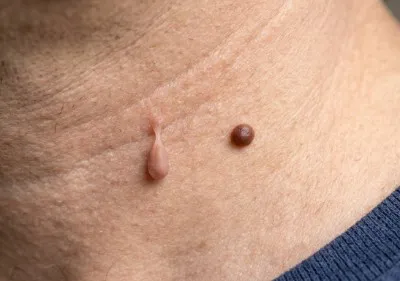
Skin growths are common at all stages of adulthood, yet many people feel uncertain when they notice something new on their skin. Part of this uncertainty stems from the fact that benign conditions can appear similar, especially in early stages or in areas with skin folds, friction, or pigmentation. Online images often show simplified examples, which can make real-life comparison less helpful rather than more reassuring.
Understanding the differences between skin tags and other growths is important for informed decision-making. Most skin changes are harmless and do not need treatment, but some features are better assessed by a professional to rule out less common concerns. Being able to recognise typical patterns and to identify clear warning signs can reduce unnecessary anxiety while ensuring that important changes are not overlooked.
This guide explains, in plain English, how skin tags typically present, how they differ from moles, warts, and seborrhoeic keratoses, and why appearance alone does not always provide a clear answer. It also covers when reassurance is usually enough, how skin tone can affect appearance, and when seeking advice is a sensible next step.
Our Preferred Partner - Jovena Fractional Plasma

Skin tag removal may be a straightforward procedure, but how the tissue is treated can make a meaningful difference to both outcomes and patient experience. That’s where fractional plasma technology on the Jovena device offers a more considered approach.
By delivering controlled plasma energy in precise micro-points, the treatment works within the upper layers of the skin to target the concern while leaving surrounding tissue largely unaffected. This supports a natural repair response, encouraging cleaner healing and more refined results over time.
For clinics, Jovena provides a versatile platform that extends beyond simple lesion removal into broader skin renewal and resurfacing treatments. For patients, it offers a precise, controlled option that aligns removal with overall skin quality - not just resolution of the concern.
Why It Can Be Hard To Identify Skin Growths At Home
Many people search for how to tell a skin tag from other skin growths after noticing a new or changing mark. While some features can seem familiar, accurate identification is often more complex than it appears.
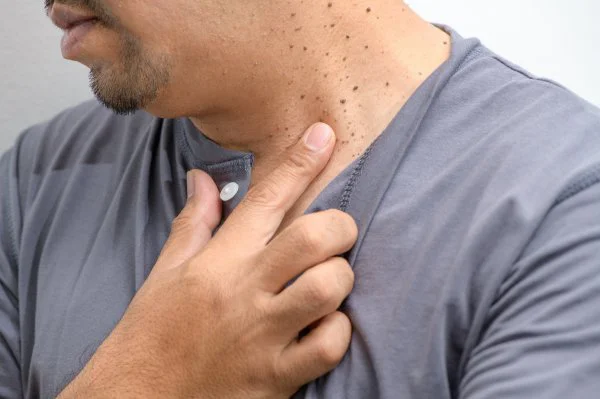
Common reasons skin growths are confused
- Several benign skin growths share similar characteristics, including size, colour, and shape, particularly in early stages.
- Changes usually happen gradually, making it harder to notice when something has changed in a meaningful way.
- Online images often show textbook examples rather than the everyday variations seen across different ages and skin tones.
Why self-diagnosis has limits
- Visual checks cannot assess what is happening beneath the skin's surface, which is often key to diagnosis.
- Some harmless growths can look unusual, while some concerning lesions may appear subtle at first.
- Lighting, camera quality, and angle can all distort appearance, increasing uncertainty rather than resolving it.
Uncertainty is common and understandable when looking at skin growths at home. Difficulty telling them apart does not mean there is something wrong, but it does explain why reassurance can be hard to provide without context.
What A Typical Skin Tag Looks And Feels Like
Understanding what a typical skin tag looks and feels like can help when comparing it with other skin growths. While appearance alone is never diagnostic, certain features are commonly seen.
Size, colour, and texture of skin tags
- Skin tags are usually small, often a few millimetres across, although they can grow larger over time.
- They are typically skin-coloured or slightly darker, rather than deeply pigmented.
- The texture is usually soft and flexible, rather than firm or hard.
How skin tags attach to the skin
- Most skin tags are attached by a narrow stalk or base, rather than sitting flat on the skin.
- This stalk can make them move slightly when touched, which often distinguishes them from other growths.
- They are usually painless unless irritated by friction, jewellery, or clothing.
Common areas where skin tags appear
- Skin tags most often develop in areas where skin rubs together, such as the neck, under the arms, under the breasts, the groin, and around the eyelids.
- They may appear as single growths or in small clusters, particularly in friction-prone areas.
When these features appear together, a skin tag is often a reasonable possibility. However, variation is normal, and not every skin tag looks the same.
Skin Tags Vs Moles: How They Usually Differ
Skin tags and moles are often mistaken for each other, particularly when a mole is raised or a skin tag is pigmented. Understanding typical differences can help clarify when reassurance is reasonable and when assessment is warranted.
Typical features of moles
- Moles usually sit flat against the skin or form a smooth, rounded dome, rather than hanging from a stalk.
- They are often evenly coloured, ranging from light brown to dark brown, although some may be pink or skin-toned.
- Benign moles tend to have a stable shape and size over long periods.
How skin tags and moles usually feel
- Skin tags are typically soft and pliable, moving easily between the fingers.
- Moles are more likely to feel firm or rubbery and do not move independently of the surrounding skin.
- A narrow attachment point is common in skin tags but uncommon in moles.
When a mole needs a professional assessment
- Any mole that changes in size, shape, colour, or sensation should be checked.
- Bleeding, crusting, or itching without obvious irritation are also reasons to seek advice.
Raised moles are not automatically concerning, but changes over time matter more than height alone.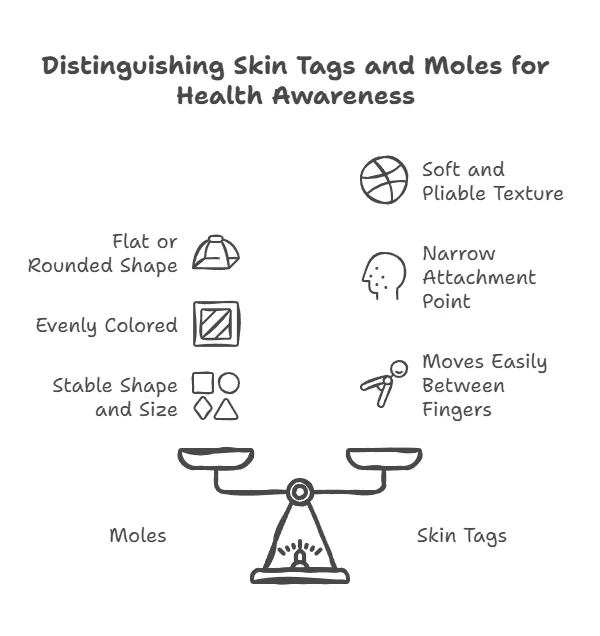
While skin tags and moles can look similar at a glance, differences in attachment, texture, and behaviour over time are often helpful indicators. Uncertainty is common, and it is reasonable to seek clarity rather than guess.
Skin Tags Vs Warts: Key Visual And Tactile Differences
Skin tags and warts are often mistaken for one another, particularly when a growth feels raised or catches on clothing. Despite this, they usually differ in surface texture, firmness, and underlying cause.
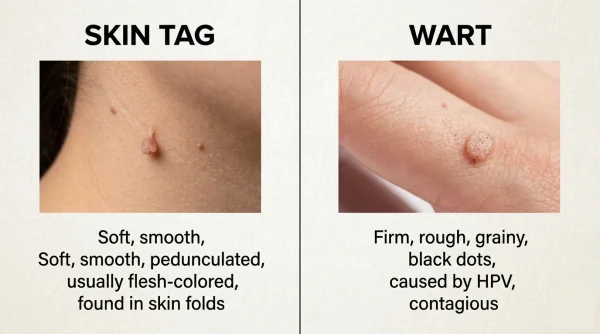
How warts usually present
- Warts often have a rough, uneven, or grainy surface rather than a smooth one.
- They tend to feel firmer than skin tags and may be tender when pressed, especially on the hands or feet.
- Small dark dots can sometimes be visible within a wart, reflecting tiny blood vessels.
Differences in attachment and movement
- Skin tags are commonly attached by a narrow stalk and may move slightly when touched.
- Warts usually sit more firmly on the skin and do not move independently of the surrounding area.
- A wart is less likely to feel floppy or flexible compared with a skin tag.
Why do warts behave differently?
- Warts are caused by a viral infection of the skin, which affects how they grow and spread.
- Skin tags are not caused by infection and do not spread through contact.
- The contagious nature of warts explains why they may appear in clusters or recur in the same area.
Surface texture and firmness are often the clearest clues when distinguishing a wart from a skin tag. Understanding these differences can reduce unnecessary worry and help guide next steps.
Skin Tags Vs Seborrhoeic Keratoses
Seborrhoeic keratoses are very common benign skin growths, particularly from midlife onwards, and are often mistaken for skin tags, moles, or warts. Their appearance can seem concerning, despite being harmless.
Typical appearance of seborrhoeic keratoses
- Seborrhoeic keratoses often appear to sit on top of the skin rather than grow out of it.
- The surface is usually waxy, scaly, or slightly crusted, rather than smooth or soft.
- Colour can vary widely, from pale beige to dark brown or almost black, even within the same person.
How do they differ from skin tags?
- Skin tags are usually soft and flexible, whereas seborrhoeic keratoses tend to feel firmer.
- Skin tags commonly hang from the skin on a narrow stalk, while seborrhoeic keratoses have a broader base.
- Seborrhoeic keratoses do not usually move when touched, unlike many skin tags.
Why age-related skin changes can be misleading
- Seborrhoeic keratoses become more common with age and are not linked to sun damage or skin cancer.
- Their uneven surface and darker colour can make them look more concerning than they are.
- Multiple growths appearing over time is typical and not usually a warning sign.
Although seborrhoeic keratoses can look unusual, they are a normal part of ageing skin for many people. Distinguishing them from skin tags often comes down to texture, firmness, and how they attach to the skin.
Warning Signs That Always Need Checking
Most skin tags and other benign skin growths are harmless. However, any change or symptom should always prompt a professional assessment, regardless of how long a lesion has been present.
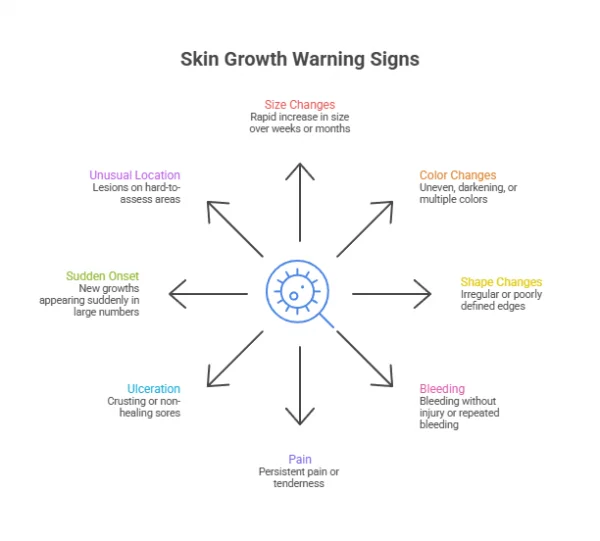
Changes in size, colour, or shape
- A growth that increases in size over a short period, particularly weeks or months, should be checked.
- Uneven colour, darkening, or multiple colours within a single lesion can be significant.
- Changes in shape, particularly the development of irregular or poorly defined edges, warrant further assessment.
Bleeding, pain, or ulceration
- Bleeding without obvious injury, or repeated bleeding from minor friction, should not be ignored.
- Persistent pain, tenderness, or a sore that does not heal are not typical features of skin tags.
- Crusting or ulceration may indicate irritation but also suggest the need for closer evaluation.
Sudden onset or unusual location
- New growths that appear suddenly in large numbers should be assessed, particularly if accompanied by other symptoms.
- Lesions on areas such as the scalp, soles of the feet, or under the nails are harder to assess visually and benefit from expert review.
These warning signs do not necessarily indicate a serious issue, but they do signal that reassurance cannot be achieved through observation alone. Timely assessment helps clarify what is benign and what needs monitoring or treatment.
Skin Growths And Skin Of Colour
Skin growths can vary by natural skin tone, making comparisons with online images less helpful. This variation is normal and does not, on its own, indicate a problem.
How pigmentation can alter appearance
- Skin tags and other benign growths may appear darker on medium to deep skin tones, even when they are harmless.
- Colour variation within a single lesion can be more noticeable, which may cause understandable concern.
- After irritation or minor trauma, temporary darkening is common and usually resolves over time.
Healing and marks after irritation or removal
- Pigment changes after friction or removal can last longer on darker skin tones.
- These changes are usually temporary but can take months to fade fully.
- Scarring risk varies by individual and technique, not by skin tone alone.
Why experience matters in assessment
- Accurate reassurance relies on familiarity with how benign lesions present across different skin tones.
- Some warning signs are subtle and easier to interpret with clinical experience.
- This is particularly relevant when changes are colour-based rather than structural.
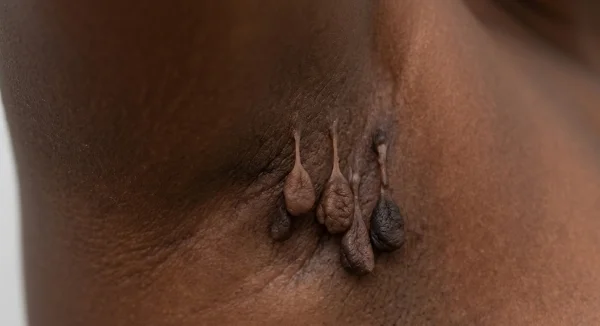
Differences in appearance across skin tones are common and expected. Understanding this context can reduce unnecessary worry and support more balanced decision-making.
When Reassurance Is Enough And When Assessment Helps
Not every skin growth needs treatment or investigation. Knowing when reassurance is reasonable and when assessment adds value can help reduce unnecessary worry while supporting sensible decision-making.
Situations where monitoring is appropriate
- A stable growth that has not changed in size, colour, or sensation over time is often suitable for monitoring.
- Skin tags that match typical features and are not causing discomfort usually do not require medical attention.
- Keeping a simple note or photograph can help you notice genuine change, rather than relying on memory.
When professional assessment adds clarity
- Assessment is helpful when a growth does not clearly fit into one category or looks different from previous cases.
- A professional opinion can confirm whether a lesion is benign and, if relevant, discuss safe removal options.
- For many people, reassurance from a qualified clinician reduces ongoing anxiety more effectively than repeated self-checking.
Choosing the right type of assessment
- A GP is often the first point of contact for new or changing skin lesions.
- Dermatology or medical aesthetics practitioners may be involved when diagnosis, monitoring, or removal is being considered.
- The setting matters less than the practitioner’s training, experience, and willingness to explain findings clearly.
Reassurance and assessment are not opposites. Monitoring is appropriate in many cases, but professional input can be a sensible step when uncertainty persists or peace of mind is hard to reach.
Conclusion
Distinguishing a skin tag from other common skin growths is not always straightforward, and uncertainty is normal when noticing changes on the skin. Many benign conditions share overlapping features, and appearance alone cannot always provide clear answers. Understanding typical characteristics, common differences, and warning signs can help place what you are seeing into context, without the pressure to reach a definitive conclusion on your own.
The most important point to remember is that most skin growths are harmless and stable over time. Changes that are gradual, symptom-free, and consistent with known benign patterns are often suitable for monitoring. Equally, recognising when something falls outside those patterns supports sensible, informed caution rather than unnecessary worry.
If uncertainty persists or a growth change is difficult to interpret, seeking professional advice is a practical and measured next step. This may be for reassurance alone or to discuss assessment and management options in a clinical setting. Taking time to reflect on what you have learned and choosing next steps that feel proportionate to your concerns supports confident and well-informed decision-making.
Your Skin Tag Removal Questions
Real Questions from Real People — Answered
Straightforward answers to the questions people like you are asking right now about Skin Tag Removal.

Be the first to ask a Skin Tag Removal question.
Click here to ask your own question.
Find A Verified Clinic
Trusted Skin Tag Removal Experts, Local to You
Easily connect with qualified, verified professionals for safe, reliable treatment.


Renew Medi Clinic
Renew Medi Clinic is a medical-led aesthetic and regenerative clinic in Brighton, offering personalised treatments focused on natural results, skin health and long-term wellbeing.

Dr Vahe Clinic
Dr Vahe Clinic is a doctor-led medical, surgical, aesthetic and longevity clinic in Chelsea, London, providing personalised, evidence-based treatments focused on safety and natural results.
To find a Skin Tag Removal clinic near you, please click here.
Grow Your Practice with Skin Tag Removal
Whether you are already using Skin Tag Removal or considering adding it to your treatment menu, here is how to make the most of it.

Are you a practitioner? If you'd like to link your practice to Skin Tag Removal and become part of ConsultingRoom.com, you can register as a verified specialist using the information on our specialist registration page.
Once verified, your profile can feature Skin Tag Removal alongside the other treatments, conditions and products you support, helping patients searching ConsultingRoom.com find you directly.