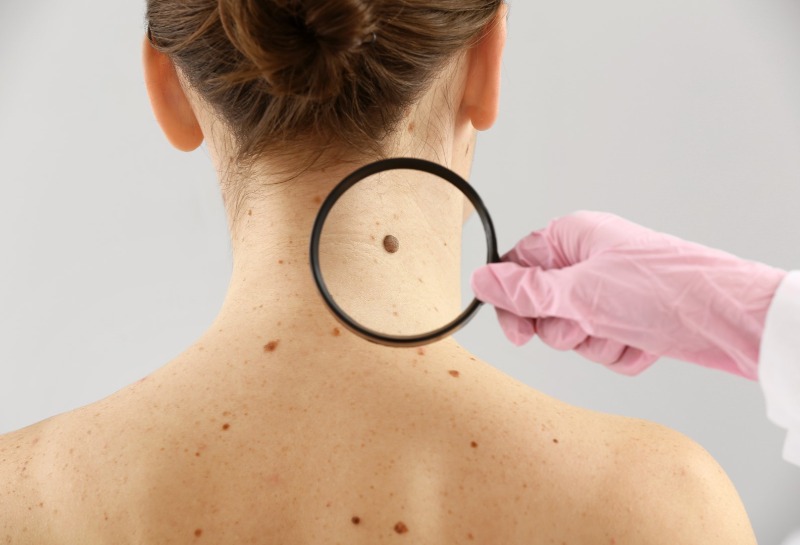
Spotting unusual moles early gives the best opportunity for intervention and cure if any abnormalities are identified.
Here’s how to perform a thorough self-check for moles:
Before you start:
- If possible enlist the help of another person to do the ‘checking’. If not, you will need a hand mirror and a full length mirror
- Set aside 5 minutes or so where you won’t be interrupted
- Choose a well lit room, so that you can clearly see skin blemishes
What to look for:
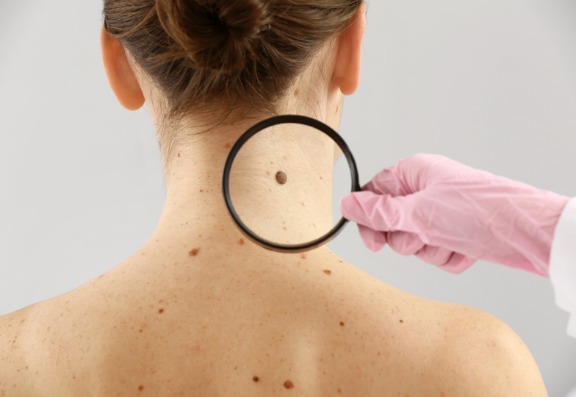
In summary, you are looking for ‘unusual’ or ugly mole compared to the other moles. It could be a fast-growing new mole or else a pre-existing mole that changes size, shape, colour or starts to bleed, itch or redden. Read more in the ABCDE rule, which describes the features of early melanoma and is described in The Facts About Moles.
How to do your mole self-check:
- Start at the top – inspect your hair, moving the parting and dividing hair for a thorough check of all the scalp. Then check your face, especially nose, lips, mouth and ears and the neck
- Start at the hands – backs, palms, between fingers – and work up from the wrists and forearms all the way to the shoulder area. Don’t forget the underside of the arms
- Thoroughly check the torso area, including chest and back and down to the buttocks/pelvis
- Starting with your feet, check your legs thoroughly – even between the toes, undersides of feet, behind knees, groin area
- Now think about any areas you might have missed – check pubic area, eyelids, behind the ears, beneath the breasts… While moles are related to sun this is not always the case, so be really thorough and leave no crease unchecked
What to do if you find a suspicious mole:
If you see any unusual mole activity or irregularities, then see a GP as soon as possible. Malignant melanoma is rare, but a dangerous and deadly form of cancer. Early intervention gives the best possible chances for recovery, which is why regular mole checks are advised.
If the mole is not of medical concern, then it can still be removed. This is a popular choice for aesthetic reasons (e.g. people don’t like the look of the mole) or convenience (e.g. it catches on clothing). Unfortunately, mole removal for non-medical reasons is not generally covered on the NHS so this would be in private clinics under local anaesthetic as a day case. Mole removal can be performed using laser mole removal or mole removal surgery, modern techniques which should only leave minimal scarring when performed by skilled and experienced doctors.
Some private mole removal clinics, like Cosmedics, also offer a full mole check which is carried out by a doctor.
What to look for:
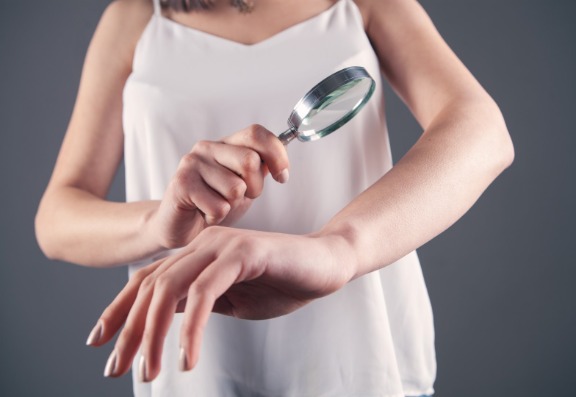
In summary, you are looking for an ‘unusual’ or ugly mole compared to the other moles.
It could be a fast-growing new mole or else a pre-existing mole that changes size, shape, and colour or starts to bleed, itch or redden. Read more in the ABCDE rule, which describes the features of early melanoma and is described in The Facts About Moles.
How to do your mole self-check:
- Start at the top – inspect your hair, moving the parting and dividing hair for a thorough check of all the scalp. Then check your face, especially the nose, lips, mouth and ears and the neck
- Start at the hands – backs, palms, between fingers – and work up from the wrists and forearms all the way to the shoulder area. Don’t forget the underside of the arms
- Thoroughly check the torso area, including the chest and back and down to the buttocks/pelvis
- Starting with your feet, check your legs thoroughly – even between the toes, undersides of feet, behind knees, groin area
- Now think about any areas you might have missed – check the pubic area, eyelids, behind the ears, beneath the breasts… While moles are related to the sun this is not always the case, so be really thorough and leave no crease unchecked
What to do if you find a suspicious mole:
If you see any unusual mole activity or irregularities, then see a GP as soon as possible.
Malignant melanoma is a rare, but dangerous and deadly form of cancer. Early intervention gives the best possible chances for recovery, which is why regular mole checks are advised.
If the mole is not of medical concern, then it can still be removed. This is a popular choice for aesthetic reasons (e.g. people don’t like the look of the mole) or convenience (e.g. it catches on clothing).
Unfortunately, mole removal for non-medical reasons is not generally covered on the NHS so this would be in private clinics under local anaesthetic as a day case. Mole removal can be performed using laser mole removal or mole removal surgery, modern techniques which should only leave minimal scarring when performed by skilled and experienced doctors.
Some private mole removal clinics also offer a full mole check which is carried out by a doctor.
If you want to read more, the experts at Consulting Room really know what they're talking about and have put together mole removal FAQs just for you.
If you have more questions, you can use the mole removal questions feature to talk to our panel of trained medical experts.
If you're keen to get started with any of these treatments right away then you're in luck - those clever folks also have a list of trusted, accredited mole removal clinics in your area.
Many thanks to the author of this blog Dr Ross Perry who Established Cosmedics Skin Clinics in 2003 in the City of London.
As most of his patients already know, he is very much a perfectionist in all aspects of his work.
Ross’s private work consists of minor surgical procedures such as mole, wart, and skin tag removal using modern methods and techniques for minimal scarring.