

Laser treatment for hyperpigmentation is one of the most searched topics in UK medical aesthetics - and also one of the most misunderstood. Part of the confusion is understandable: there are several different laser technologies in use; they work differently and suit different conditions and skin types. What works well for a sun spot on fair skin may be entirely the wrong approach for melasma on a deeper skin tone. Most online content does not make that distinction clearly enough.
Hyperpigmentation itself covers a broad range of conditions. Post-inflammatory marks left by acne, sun damage, hormonal melasma, and age spots all involve excess melanin - but they sit at different depths in the skin, respond differently to treatment, and carry different risks depending on the individual. That variation is why a single answer to "Does laser work for pigmentation?" is rarely the whole picture.
There is also the question of safety. The risk that laser treatment can trigger new pigmentation - particularly in Brown and Black skin tones - is real and documented, yet it is frequently absent from clinic-facing content. Understanding which technologies reduce that risk, and what to ask before committing to a course of treatment, is as important as understanding the treatment itself.
This guide works through the key questions: how lasers target pigmentation, which conditions respond well, what the risks are for different skin types, what realistic results look like, and how to approach the decision of whether laser is the right option for you.
To understand how laser treatment works - and why the type of laser matters as much as the treatment itself - it helps to start with the science.
Our Preferred Partner - LaserMe by Neauvia
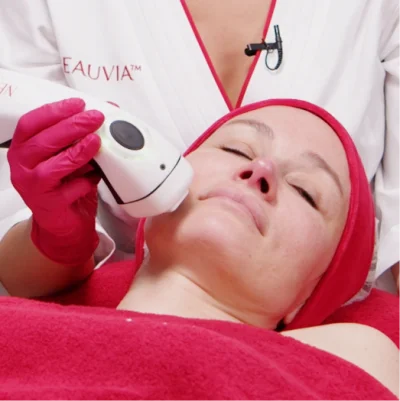
LaserMe is a non-ablative fractional diode laser used in medical aesthetics clinics across the UK to support skin regeneration and pigmentation management. This guide is for anyone trying to understand what it is, how it works, and whether it may be relevant to their hyperpigmentation concern.
- What LaserMe is, and how it differs from ablative laser treatments
- Which pigmentation concerns it is commonly used for, including PIH, melasma, and sun damage
- What to consider around suitability, recovery, costs, and choosing a qualified practitioner
How Do Lasers Target Pigmentation?
Laser treatment for hyperpigmentation works by delivering focused light energy into the skin - but the science behind it is worth understanding before you book anything.
The principle of selective targeting
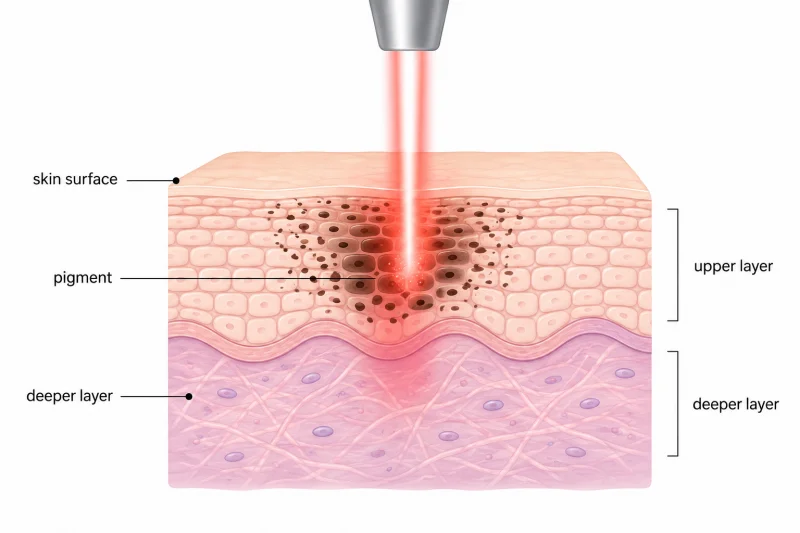
Lasers used for pigmentation are designed around a concept called selective photothermolysis. In simple terms, the laser emits a specific wavelength of light that is preferentially absorbed by melanin - the pigment responsible for dark spots - rather than by surrounding tissue. The energy heats and disrupts the melanin deposits, which the body then gradually breaks down and clears away.
In practice, this means the laser targets pigment rather than simply heating the whole area. How well that targeting works depends partly on the laser type, and partly on where the pigment sits within the skin.
Why depth matters
Not all pigmentation sits in the same layer of skin. Sun spots and many post-inflammatory marks tend to sit in the upper layer (the epidermis), where lasers can reach and clear them more reliably. Melasma and some older or deeper marks can extend into the dermis - the layer beneath - where laser energy has more difficulty penetrating evenly and where results are less predictable.
This distinction matters because a treatment that efficiently clears one type of pigmentation may have limited effect on another, or even trigger new pigmentation if the skin's inflammatory response is activated. Understanding this helps explain why a consultation and proper diagnosis should always precede any decision about laser treatment.
The effectiveness of any laser for pigmentation is not just about the device - it is about matching the right technology to the right depth, skin type, and condition.
What Types Of Laser Are Used For Skin Pigmentation In The UK?
Several different laser and light-based technologies are used for pigmentation treatment in UK clinics, and they are not all the same. Understanding the main options helps you ask better questions and have a more informed conversation at the consultation.
Q-switched lasers
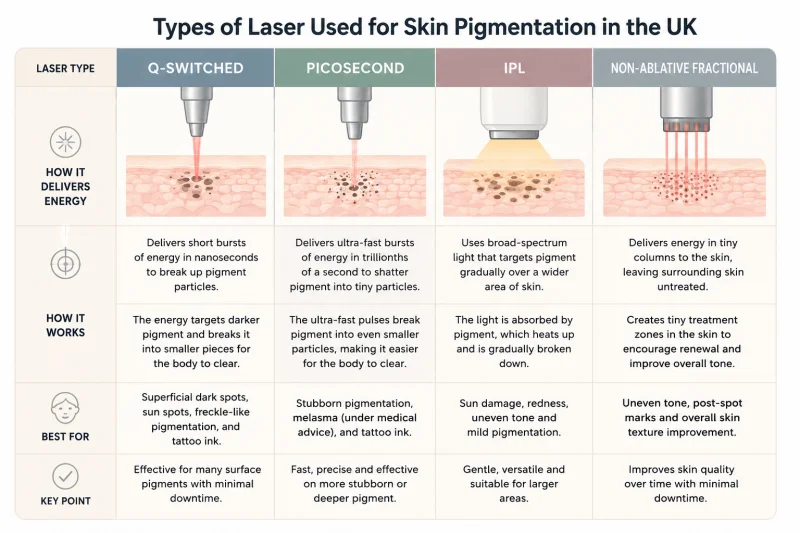
Q-switched lasers - particularly the Nd:YAG at 1064 nm and 532 nm wavelengths - are among the most widely used options for pigmented lesions. They deliver very short pulses of high-intensity energy that shatter melanin deposits without prolonged heat exposure to surrounding tissue. They are considered a reliable choice for a range of epidermal pigmentation conditions and have a broad evidence base.
Picosecond lasers
Picosecond lasers work on a similar principle to Q-switched devices but deliver energy in even shorter pulses - measured in trillionths of a second. This can reduce the thermal effect on surrounding skin, which is relevant for tolerability and recovery. They are increasingly used in UK clinics, though the evidence base is still developing compared to Q-switched technology.
Intense pulsed light (IPL)
IPL is not technically a laser - it emits a broad spectrum of light rather than a single wavelength. It can be effective for certain surface pigmentation, such as sun damage and diffuse redness, but it offers less precision than dedicated laser devices and is generally considered less suitable for complex pigmentation or darker skin tones.
Non-ablative fractional lasers
Non-ablative fractional technology works differently from the above. Rather than treating the entire surface, it creates thousands of microscopic treatment zones in the skin while leaving the surrounding tissue intact. This means the skin retains a reservoir of healthy cells to support faster recovery, and the inflammatory response - which can trigger new pigmentation - is significantly reduced. Devices such as LaserMe, a non-ablative fractional diode laser available through UK clinics, use this approach. It is one reason this category of laser is increasingly considered across a wider range of skin types.
In practice, many clinics use a combination of technologies depending on the condition being treated and the individual's skin type. No single device suits every situation.
Which Pigmentation Conditions Respond Best To Laser?
Laser can be an effective option for a range of pigmentation conditions, but how well it works depends significantly on the type of pigmentation being treated - and being clear about that distinction before starting any treatment matters.
Conditions that tend to respond well
Some types of hyperpigmentation are well-suited to laser treatment, particularly where pigment sits close to the skin's surface:
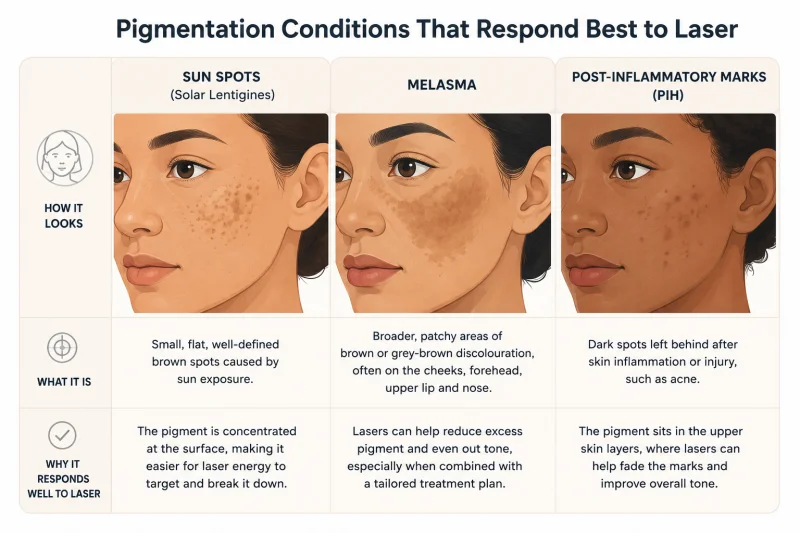
- Solar lentigines (sun spots and age spots): These are generally epidermal in origin and respond predictably to laser treatment, often with noticeable improvement in a small number of sessions.
- Superficial post-inflammatory hyperpigmentation (PIH): Marks left by acne, minor skin trauma, or inflammation that sit in the upper skin layer can respond well, though skin tone affects how treatment is approached (covered in the next section).
- Freckles and diffuse sun damage: Surface-level pigmentation of this kind is among the more straightforward indications for laser treatment.
Conditions where laser is more complicated
- Melasma: This is one of the most challenging pigmentation conditions to treat with laser. Melasma often involves both epidermal and dermal pigment, and is driven by hormonal and UV factors that laser cannot address at the root. Clinical evidence consistently shows that laser alone is rarely sufficient - and in some cases, the heat involved can trigger a rebound flare. A 2024 review in the Journal of Clinical Medicine noted that treating melasma with laser therapy may be ineffective unless combined with photoprotection and depigmenting agents.
- Deeper or dermal PIH: Where pigment has settled into the deeper skin layers, laser reaches it less reliably, and results are more variable.
- Hormonally driven or drug-induced pigmentation: These require addressing the underlying cause before any laser treatment is considered.
That said, lasers can still play a useful role in melasma management as part of a broader, combination treatment plan - it simply should not be presented or expected as a standalone fix.
Is Laser Safe For Darker Skin Tones?
This is one of the most important questions in pigmentation treatment - and one that does not get a straight answer often enough in consumer-facing content.
The real risk: when laser triggers more pigmentation
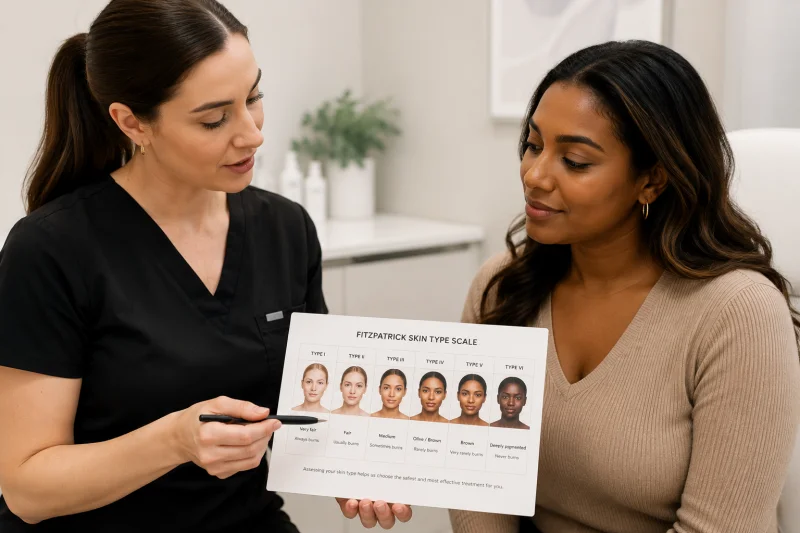
The concern with laser treatment in darker skin is not unfounded. People with Fitzpatrick skin types III to VI - which includes a broad range of South Asian, East Asian, Middle Eastern, Black, and mixed heritage skin tones - have more reactive melanocytes. When skin in this group experiences thermal injury, those melanocytes can overreact, producing new or worsened pigmentation in response to the treatment itself. This is known as post-inflammatory hyperpigmentation (PIH), and it is a well-documented risk rather than a rare complication.
According to StatPearls (2024), PIH is more common and more severe in individuals with Fitzpatrick skin types III to VI, due to increased melanin production and more reactive melanocytes. In other words, a poorly chosen laser protocol does not just fail to treat the problem - it can make it significantly worse.
Why does this not mean laser is off the table?
That risk is real, but it is not the whole picture. The key variable is the type of laser used and how it is applied.
Non-ablative fractional technology has shown meaningfully lower PIH risk in darker skin tones compared to older or more aggressive laser approaches. By treating only a fraction of the skin's surface at a time and leaving surrounding tissue intact, the inflammatory response is substantially reduced. A retrospective study examining non-ablative fractional 1927 nm laser in patients with Fitzpatrick types IV to VI reported a mean improvement of over 43% with no side effects recorded.
Devices such as LaserMe use non-ablative fractional diode technology - an approach designed to minimise thermal damage to surrounding tissue, which is directly relevant to PIH risk management in higher Fitzpatrick skin types.
What to ask before treatment
For anyone with a brown or black skin tone, a few questions are worth raising at a consultation:
- Has the practitioner specifically treated patients with your Fitzpatrick skin type before?
- Which laser technology is being proposed, and why is it appropriate for your skin tone?
- Will a patch test be carried out before a full treatment session?
- What is the plan if PIH occurs?
The technology matters. The practitioner's experience matters at least as much.
How Many Sessions Will I Need - And What Does It Cost In The UK?
Two of the most common questions before any laser treatment are how many sessions to expect and what the total cost is likely to be. The honest answer to both is: it depends - but there are useful ranges to work from.
How many sessions?
Session numbers vary considerably by condition type, pigment depth, skin tone, and the technology being used. As a general guide:
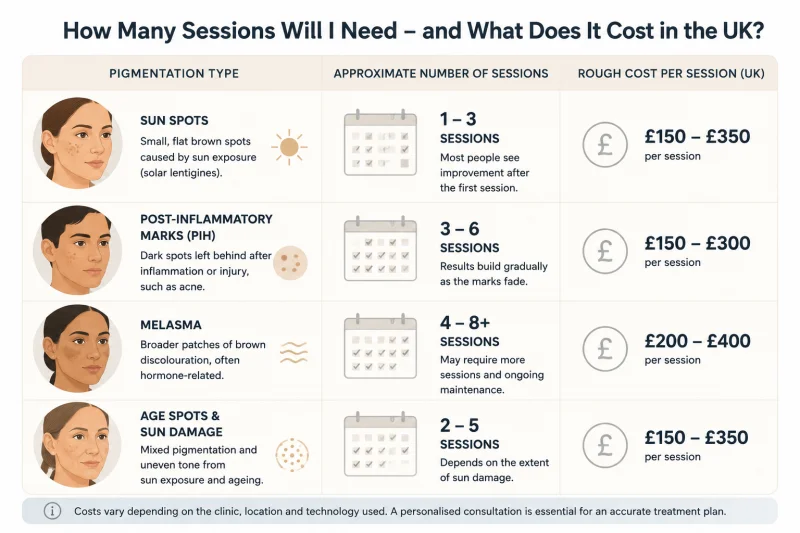
- Solar lentigines and surface sun damage: Often respond within 1 to 3 sessions.
- Superficial post-inflammatory hyperpigmentation: Typically 3 to 6 sessions, depending on depth and skin type.
- Melasma: Generally requires more - often 4 to 10 sessions or more - and ongoing maintenance to manage recurrence. Results are less predictable than for other conditions.
- Deeper or dermal pigmentation: Session numbers tend to be higher and outcomes less certain.
Sessions are usually spaced 4 weeks apart to allow the skin to recover and respond between treatments.
What does laser pigmentation treatment cost in the UK?
UK pricing varies by treatment type, clinic location, practitioner experience, and the technology used. Based on current clinic pricing:
- Standard laser pigmentation removal: Roughly £150 to £400 per session.
- Non-ablative fractional laser treatments: Typically £300 to £800 per session for facial areas.
- More intensive ablative laser resurfacing: Can range from £635 upwards per session at specialist clinics.
London and major city clinics - particularly those in Harley Street or equivalent premium locations - tend to sit at the higher end. Clinics outside these areas may offer comparable technology at lower per-session rates.
The total cost consideration
Single-session pricing can be misleading. For conditions requiring multiple treatments, the total cost of a full course is the more relevant figure to request at consultation. A course of 6 sessions at £200 each represents a £1,200 investment - and that figure does not include the topical maintenance products or SPF that good aftercare requires.
It is also worth asking whether patch testing is included, and whether follow-up reviews are charged separately.
What Happens During A Laser Treatment Session?
Knowing what to expect on the day can make the process feel considerably less daunting. A laser pigmentation treatment session follows a fairly consistent structure across most reputable UK clinics, though the finer details vary by technology and the area being treated.
Before the treatment begins
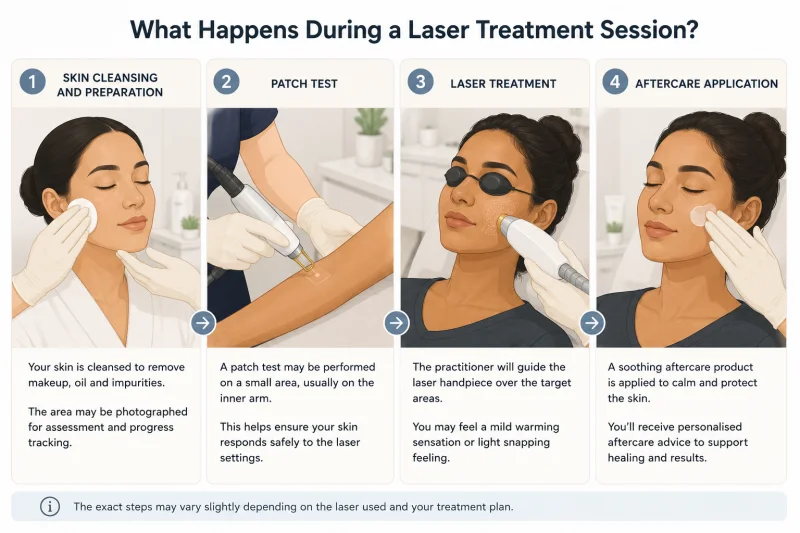
For first-time patients, a patch test is standard practice before any full treatment session. This involves applying the laser or light device to a small area of skin - often behind the ear or on the inner arm - and monitoring for any adverse reaction over the following days. It is a straightforward precaution, but an important one.
On the day of treatment, the skin is typically cleansed, and any topical numbing cream, if used, is applied in advance and left to take effect. The practitioner will review the treatment plan and confirm the targeted area.
During the session
The treatment itself involves the device handpiece being passed carefully over the skin in the target area. Most patients describe a mild warmth or a light snapping sensation during treatment. The intensity varies depending on the laser type and the settings used.
Session length depends on the size of the area being treated - facial treatments typically take between 20 and 45 minutes. Cooling is often built into the device or applied separately to protect the skin surface and improve comfort.
Non-ablative fractional treatments
For non-ablative fractional laser treatments - including devices such as LaserMe - there is no removal of the skin surface. The skin remains intact throughout, which means the immediate post-treatment response is generally mild. Some redness or minor swelling in the treated area is common and typically resolves within a few hours to a day. Most patients return to normal activity the same day.
Ablative treatments, by contrast, involve more significant downtime and a more pronounced recovery period, which is one reason non-ablative fractional options have become more widely used for pigmentation in clinical practice.
A good practitioner will talk you through exactly what to expect before, during, and after your specific treatment.
What Results Can I Realistically Expect?
Managing expectations before laser pigmentation treatment is as important as the treatment itself. Results vary - sometimes considerably - and understanding why helps avoid disappointment.
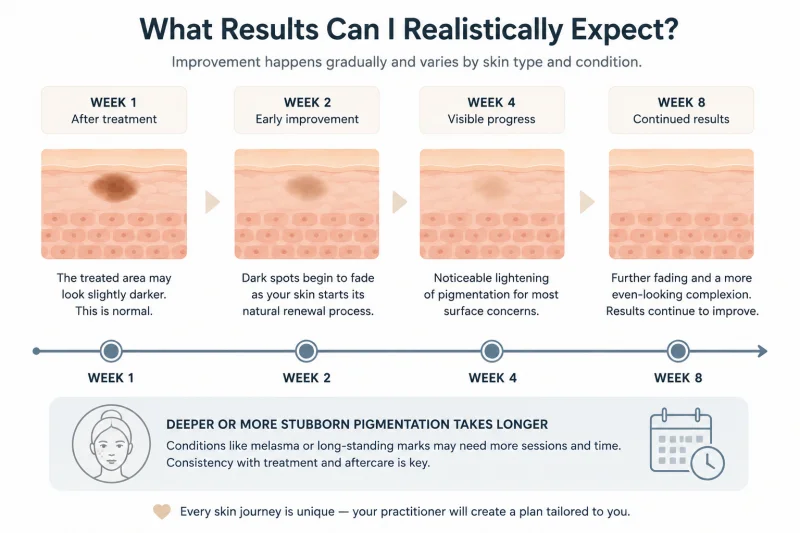
How quickly do results appear?
The timeline depends on the condition being treated and the technology used. For surface-level pigmentation such as sun spots, some fading is often visible within 2 to 4 weeks of the first session. In many cases, treated spots temporarily darken immediately after laser before gradually lightening - this is a normal part of the process as the disrupted melanin makes its way to the skin surface.
For deeper or more complex conditions, improvement tends to be more gradual. Multiple sessions are usually needed before meaningful change is visible, and each session builds on the last.
What affects outcomes?
Several factors influence how well laser works for any individual:
- Pigment depth: Epidermal pigmentation responds more predictably than dermal or mixed pigmentation.
- Skin tone: As covered in an earlier section, Fitzpatrick skin type affects both the risk profile and the parameters used, which in turn influences outcomes.
- Sun exposure: UV exposure between sessions can counteract progress. Consistent SPF use is not optional - it is a clinical requirement for results to hold.
- Condition type: Melasma, in particular, is prone to recurrence regardless of how well initial sessions go, if hormonal triggers or UV exposure remain unmanaged.
- Treatment approach: Clinical evidence consistently shows that combining laser with topical depigmenting agents and photoprotection yields better, more durable outcomes than laser alone.
Is the result permanent?
For discrete, stable pigmentation such as solar lentigines, results can be long-lasting with appropriate sun protection. For conditions driven by hormones, inflammation, or ongoing UV exposure - particularly melasma - recurrence is common and maintenance treatment is often necessary.
In practice, laser is best understood as a tool within a longer-term skin management plan rather than a single curative event. A realistic treatment plan, discussed and agreed upon at consultation, is a more reliable indicator of satisfaction than any individual session outcome.
Your Hyperpigmentation Questions
Real Questions from Real People — Answered
Straightforward answers to the questions people like you are asking right now about Hyperpigmentation.

Be the first to ask a Hyperpigmentation question.
Click here to ask your own question.
Find A Verified Clinic
Trusted Hyperpigmentation Experts, Local to You
Easily connect with qualified, verified professionals for safe, reliable treatment.

Skin Redefined Ltd
Skin Redefined is a Cheltenham-based aesthetics clinic specialising in regenerative skin treatments, anti-ageing solutions, and natural-looking results led by Nurse Prescriber Kelly Whittaker.
Dr Ed Robinson Clinics
Doctor-led medical aesthetics, skin & laser clinic in Hale, Cheshire
To find a Hyperpigmentation clinic near you, please click here.
Grow Your Practice with Hyperpigmentation
Whether you are already using Hyperpigmentation or considering adding it to your treatment menu, here is how to make the most of it.

Are you a practitioner? If you'd like to link your practice to Hyperpigmentation and become part of ConsultingRoom.com, you can register as a verified specialist using the information on our specialist registration page.
Once verified, your profile can feature Hyperpigmentation alongside the other treatments, conditions and products you support, helping patients searching ConsultingRoom.com find you directly.
Our Preferred Partner:
As more patients research hyperpigmentation online before booking a consultation, having your clinic listed against this condition on ConsultingRoom.com is becoming an increasingly valuable way to reach them. From melasma and post-inflammatory pigmentation to sun damage and age spots, patients turn to pages like this to understand their options before choosing a practitioner.
If your clinic treats hyperpigmentation, our dedicated practitioner resource explains everything you need to know, including how to get listed, showcase your expertise and connect with patients actively searching for treatment.
Find out how being listed here could help grow your clinic and connect you with patients seeking trusted, qualified care.