
Full Report - Section 6
Patient behaviour and the psychological shift
If regulation reshapes structure and training reshapes professionalism, patient behaviour reshapes demand.
And 2026 patients are different.
Not louder. Not trend-driven. Just more selective, more informed and more cautious.
Across practitioner and brand insights, one theme stands out: patients are thinking longer-term.
From transformation to refinement
The overt “change my face” era is softening.
Practitioners consistently report:
- Preference for subtle outcomes
- Phased treatment plans
- Greater acceptance of gradual improvement
- Reversal of previous overfilling
The normalisation of filler dissolving is particularly telling. Dissolving is no longer automatically viewed as failure. It is increasingly seen as part of refinement and taste evolution. This signals something important psychologically:
Patients want flexibility.
They want treatments that can be adjusted, reassessed and recalibrated over time.
Clinics that communicate reversibility and staged planning build confidence.
Informed selectivity
Patients are arriving at consultations better researched.
They are asking about:
- Training background
- Complication management
- Brand choice
- Longevity of outcomes
- Evidence behind claims
- Practitioners Outlook 2026
This is not scepticism. It is maturity.
Social media has created awareness, but it has also created fatigue. Many patients are now actively rejecting overfilled aesthetics and exaggerated marketing narratives. Trust is being rebuilt through clarity, not spectacle.
The rise of the “long-term thinker”
Another behavioural shift is the move from one-off treatments to structured journeys.
Patients increasingly accept:
- 6–12 month plans
- Combination protocols
- Maintenance cycles
- Preventative intervention in younger cohorts
- Practitioners Outlook 2026
This aligns with the regenerative and longevity movement.
The question patients are asking has shifted from:
“How do I look next week?”
to:
“How will my skin behave over the next few years?”
That is a deeper psychological commitment.
Menopause and midlife as a driving force
One of the most significant demographic shifts shaping behaviour is the rise of midlife women seeking informed, physiology-aware care.
These patients:
- Are highly educated
- Have disposable income
- Value professional credibility
- Seek hormonal awareness in planning
- Prioritise skin resilience over volume
They do not respond well to urgency-based marketing.
They respond to:
- Clear explanation
- Respectful tone
- Structured pathways
- Biological rationale
Clinics that adapt consultation language accordingly will convert more effectively in this segment.
Psychological safety in consultation
There is a quieter but important development.
Practitioners are placing greater emphasis on expectation management, emotional literacy and ethical refusal.
Patients are more aware of body image pressures.
This creates two responsibilities:
- Identify unrealistic expectations
- Protect long-term patient confidence
In 2026, saying “no” appropriately may be as valuable as saying “yes”.
Ethical restraint is becoming a marker of expertise.
Digital behaviour and response expectations
Patient psychology is also shaped by technology.
Software providers report that missed calls and delayed responses significantly impact patient engagement.
Patients now expect:
- Rapid response
- Multi-channel communication
- Transparent booking systems
- Follow-up messaging
Patience is shorter.
Tolerance for being put on hold is low.
Operational responsiveness now influences perception of professionalism.
Economic pressure and risk aversion
While demand remains strong, economic pressure subtly influences behaviour
Twelve-month outlook for the UK…
Patients are:
- Spacing treatments
- Choosing fewer but higher-impact interventions
- Comparing clinics more carefully
- Evaluating long-term value
They are not abandoning aesthetics. They are prioritising more strategically.
Clinics that position treatments as investments in long-term skin behaviour rather than aesthetic indulgences align better with this mindset.
What this means for consultation strategy
The psychological shift requires adaptation.
In 2026, effective consultation includes:
- Clear explanation of mechanism
- Visual tracking and measurable milestones
- Honest discussion of reversibility
- Realistic downtime expectations
- Long-term planning rather than instant promises
Structure reduces anxiety.
Clarity reduces regret.
Patients who feel informed are more likely to commit and return.
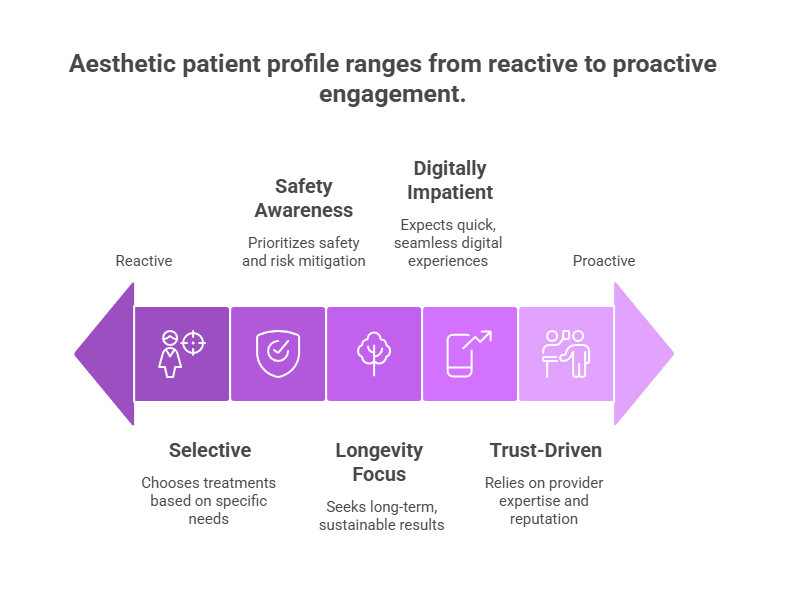
The core behavioural themes of 2026
Across all sources, the behavioural pattern consolidates into five traits:
- Selective
- Safety-aware
- Longevity-focused
- Digitally impatient
- Trust-driven
Clinics that match tone and structure to these traits will thrive.
Those who continue urgency-led, transformation-heavy messaging may experience increasing friction.
The bigger picture
Patient behaviour is not becoming more difficult.
It is becoming more sophisticated.
The UK aesthetic market is maturing in tandem with its consumer base
That maturity rewards:
- Transparent communication
- Structured journeys
- Ethical positioning
- Clinical credibility
In many ways, the patient psychology shift supports the sector’s broader professionalisation.