
Full Report - Section 5
Training, workforce and professional identity
If regulation raises the bar and financial discipline protects margins, training defines who belongs in the market.
Across the project insights, one theme is consistent: 2026 is a credibility year.
The era of superficial qualification is narrowing. Depth, documentation and defensible competency are rising to the surface.
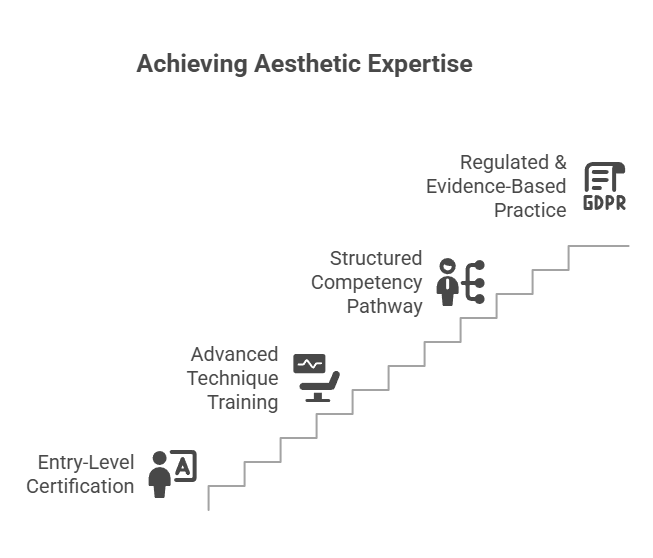
The shift away from short-form education
Training providers report a clear evolution in what practitioners are requesting.
While foundation toxin and filler training remains essential, there is growing demand for:
- Advanced anatomy-led programmes
- Regenerative technique depth
- Skin quality modalities
- Women’s health and menopause integration
- Complication management
- Training and conferences
This is not cosmetic curiosity. It is a professional recalibration.
As the sector matures, practitioners recognise that aesthetics is no longer perceived as low-risk or lightweight medicine.
Education must reflect that reality.
Competency over attendance
One of the most important developments is the shift toward competency-linked validation.
Industry voices anticipate licensing structures requiring:
- Documented supervised cases
- Logbooks
- Device-specific accreditation
- Reflective practice
- Complication evidence tracking
The implication is clear:
Attendance certificates alone will not be enough.
Clinics that begin documenting structured competency progression now will reduce stress later.
The professionalisation of mentorship
Another noticeable trend is the move toward longitudinal training models.
Rather than one-off advanced days, there is growing emphasis on:
- Mentorship pathways
- Peer review
- Anatomy refreshers
- Structured CPD cycles
This mirrors broader healthcare training culture.
Aesthetics is aligning more closely with surgical and medical education standards.
That alignment strengthens the sector’s legitimacy.
The workforce maturity curve
There is also a workforce shift occurring.
Early rapid expansion allowed a wide range of practitioner backgrounds into the sector. As regulation tightens and scrutiny increases, the hierarchy is clarifying.
Practitioners with:
- Medical grounding
- Formal anatomy depth
- Complication readiness
- Governance awareness
will likely experience rising demand.
This does not mean exclusion. It means differentiation.
The market is separating hobbyist injectors from healthcare-led providers.
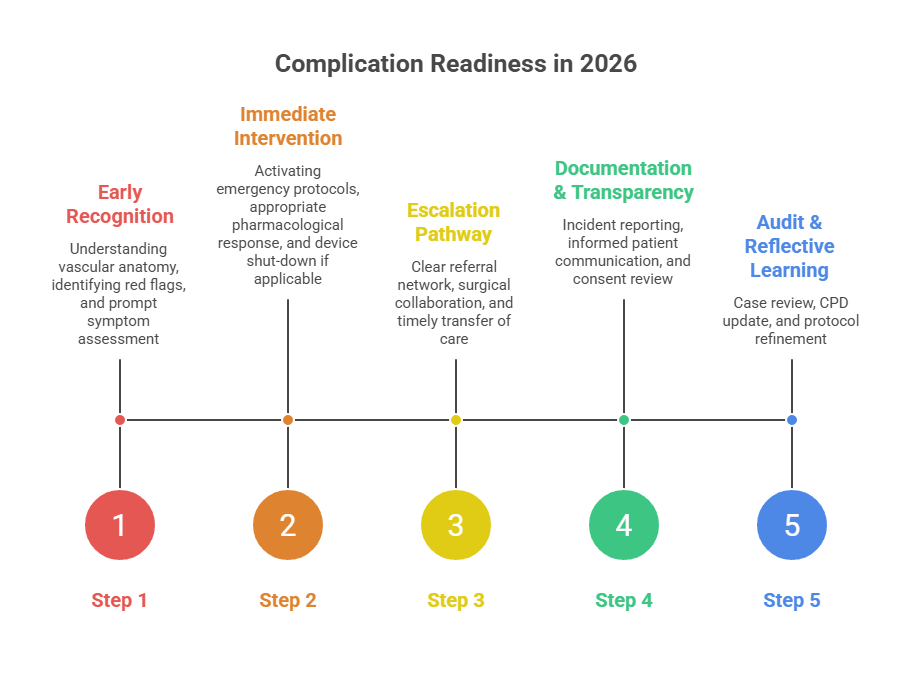
Complication management as identity marker
Across multiple sources, complication management is highlighted as non-negotiable.
In 2026, your ability to:
- Recognise early vascular compromise
- Escalate appropriately
- Document adverse events
- Communicate transparently
is not just clinical skill. It is brand protection.
Clinics that openly invest in complication training signal maturity.
Patients notice.
The menopause and midlife influence
Education demand is also expanding into women’s health and hormonal awareness.
Perimenopausal and menopausal patients represent one of the fastest-growing, highest-value demographics in aesthetics.
Understanding:
- Oestrogen-linked collagen decline
- Barrier instability
- Inflammatory shifts
- Healing variability
is becoming part of comprehensive aesthetic planning.
Training that integrates these factors strengthens clinical positioning.
Psychological safety and consultation skill
An emerging theme is psychological literacy.
As patient expectations evolve, consultation is becoming the most decisive stage of treatment planning.
Practitioners are increasingly expected to:
- Manage unrealistic expectations
- Identify body dysmorphic risk
- Explain phased treatment logic
- Decline inappropriate requests
These are communication skills developed through experience and structured learning.
Technical injection skill alone is insufficient.
Recruitment and retention of staff
For clinic owners, workforce stability is also a financial issue.
In a tightening market:
- Skilled injectors are more selective
- Governance-heavy clinics require structured onboarding
- Mentorship attracts stronger candidates
Clinics that provide:
- Documented progression pathways
- Formalised CPD
- Regular case review sessions
- Clear scope of practice
will retain better teams.
Professional identity strengthens recruitment.
The bigger identity question
The industry is at a crossroads.
Is aesthetics a cosmetic service industry, or is it a medically governed speciality?
The voices in the project materials lean strongly toward the latter.
2026 is not just about compliance.
It is about professional identity.
- Clinics that position themselves as:
- Medically grounded
- Evidence-aware
- Governance-driven
- Education-led
will align with regulatory direction, patient expectation and long-term sustainability.
Those who rely solely on marketing momentum may feel increasing pressure.