
Full Report - Section 4
Financial discipline, pricing and lifetime value
If regulation shapes structure, and regeneration shapes clinical direction, financial discipline shapes survival.
2026 is not predicted to be a collapse year. Demand remains strong. But it is a more selective, margin-sensitive, performance-measured environment. The growth model is changing.
The new consumer reality: Selective, value-conscious, informed
Business services providers and brands both highlight that patients remain engaged, but they are:
- Spacing treatments further apart
- Prioritising high-impact procedures
- Comparing clinics more carefully
- Evaluating value rather than simply chasing offers
- Business Services Trends
Practitioners report rising competition and increased price sensitivity in local markets. This creates pressure in two directions:
- Maintain premium positioning
- Protect margins
Clinics that default to discounting may win volume in the short term but weaken long-term profitability.
The decline of aggressive discounting
There is a consistent warning across the sources: discount-led growth is fragile.
- Business advisers emphasise the move toward:
- Value-based pricing
- Lifetime value models
- Recurring revenue
- Membership and staged treatment plans
- Business Services Trends
Brands reinforce that sustainable positioning is built around durability, safety and partnership rather than price competition.
Discounting erodes brand equity.
Value-based positioning builds resilience.
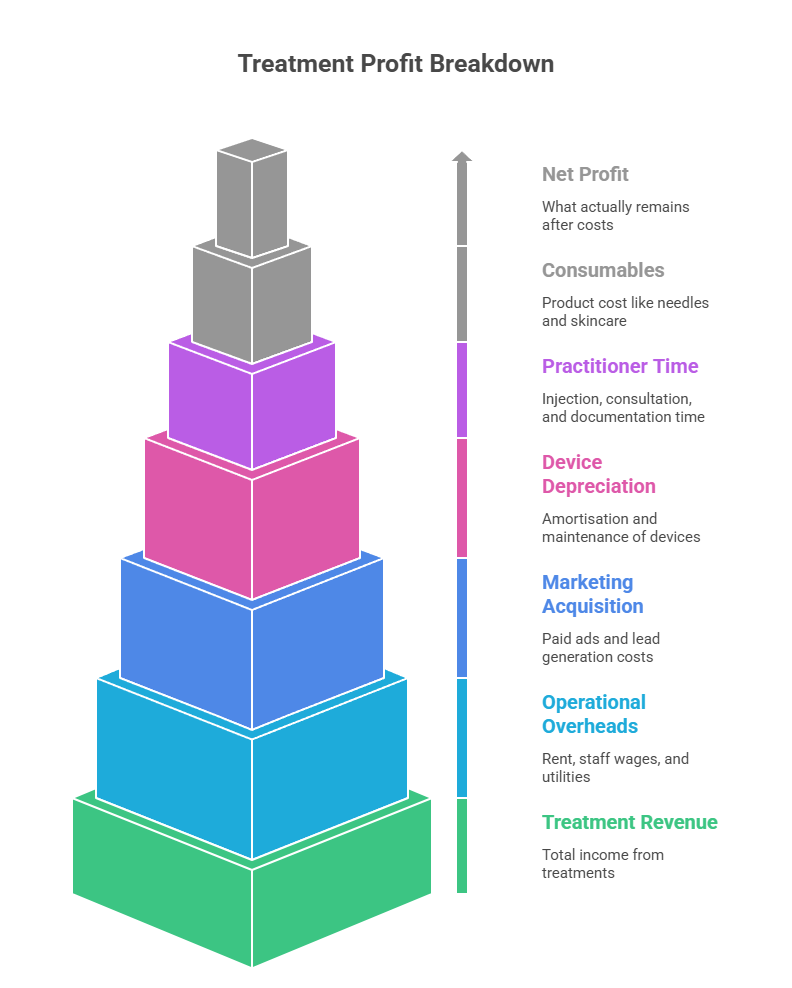
Profit PER TREATMENT: The metric that matters
One of the clearest commercial themes is this:
Revenue is not the same as profit.
Many clinics still track turnover rather than:
- Cost per treatment
- Practitioner time value
- Consumable cost
- Device depreciation
- Marketing acquisition cost
- Net profit margin
Business consultants repeatedly note that financial literacy will separate strong operators from vulnerable ones. If you do nothing else this quarter, calculate:
True profit per treatment category.
You may discover that your “most popular” service is not your most profitable.
Lifetime value as the stability strategy
The sector’s regenerative shift naturally supports lifetime value models.
Structured pathways and staged plans encourage:
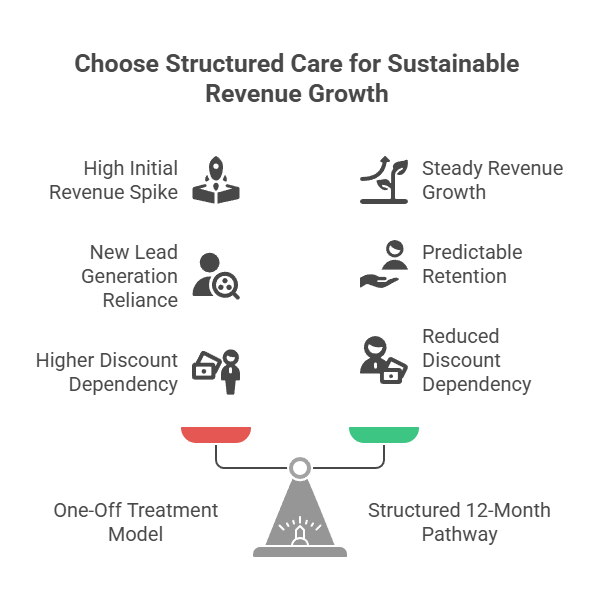
- Predictable rebooking
- Higher cumulative spend
- Reduced reliance on constant new leads
Brands explicitly promote membership and programme-based care to support long-term economics.
Business advisers echo this, highlighting recurring revenue as a buffer against seasonal volatility.
A patient on a structured 12-month collagen pathway is far more commercially stable than a patient chasing single discounted sessions.
Membership models: When they work, when they fail
Memberships can be powerful. They can also fail.
They work when:
- Built around clinical logic, not arbitrary monthly discounts
- Integrated with structured treatment planning
- Supported by CRM tracking
- Positioned as skin health continuity
They fail when:
- Purely price-led
- Too complex
- Not operationally supported
- Undermining premium positioning
In 2026, retention is replacing acquisition as the primary growth lever.
Retention reduces ad spend pressure.
Marketing spend and cost of acquisition
Paid social remains important, but reliance on one channel is increasingly risky.
Rising ad costs and algorithm shifts mean:
- Cost per acquisition can spike unpredictably
- Conversion tracking must improve
- Multi-channel strategies become essential
Financial discipline now includes:
- Tracking cost per lead
- Tracking consult-to-treatment conversion
- Tracking rebooking rate
- Measuring lifetime value
Without these, clinics operate on instinct rather than data.
The margin pressure equation
Let’s look at the forces converging in 2026:
- Rising operating costs
- Increased insurance scrutiny
- Training investment requirements
- Higher device sophistication
- Selective consumer behaviour
- Stronger competition
Without structured financial planning, these pressures compress margins quickly.
The clinics that thrive will:
- Know their break-even monthly number
- Track utilisation rates
- Review pricing quarterly
- Adjust service mix strategically
Growth is no longer about adding treatments. It is about optimising structure.
Pricing strategy: What changes in 2026
Successful pricing in 2026 will likely reflect:
- Transparent consultation fees
- Package pricing for staged protocols
- Clear explanation of treatment durability
- Reduced flash sales
- Structured loyalty rather than ad hoc discounts
The messaging shifts from:
“Special offer available now”
to
“Here is your structured treatment plan for the year.”
Patients seeking longevity and regeneration respond better to structure than urgency.
Financial governance as reputation
There is a subtle but important reputational layer.
Clinics that:
- Avoid over-treatment
- Decline inappropriate requests
- Offer staged approaches
- Demonstrate cost clarity
build trust.
Practitioners consistently highlight ethical decision-making as a differentiator.
Ethics and profitability are no longer opposing forces.
In 2026, they reinforce each other.
The broader market pattern
The industry is consolidating around:
- Professionalism
- Data
- Structure
- Long-term planning
Financial discipline sits at the centre of that consolidation
The “fast-growth, low-barrier” phase is fading.
What replaces it is calmer, more strategic, more defensible business models.