


Patients form impressions of a clinic long before treatment begins.
They notice the website, the reception area, the tone of communication, the treatment environment and the way the team presents itself.
For private clinics, particularly those operating in competitive aesthetic, cosmetic and specialist healthcare markets, those details matter because they collectively shape how professional, considered and trustworthy the clinic feels.
Uniforms are part of that experience.
Yet they are often treated as a purely functional purchase.
Choose a scrub colour. Add a name. Add a logo. Place the order.
That approach may be practical, but it can overlook the role team presentation plays in the wider clinic brand.
Your team is one of the most visible parts of your clinic
Private clinics put considerable thought into how they present themselves.
Brand colours are chosen carefully. Websites are designed to reflect a particular level of quality. Treatment rooms are styled intentionally. Signage, photography and social media are expected to feel consistent.
The clinical team should feel connected to that same identity.
This does not mean turning every member of staff into a walking advertisement.
In many cases, the strongest clinic uniforms are relatively understated.
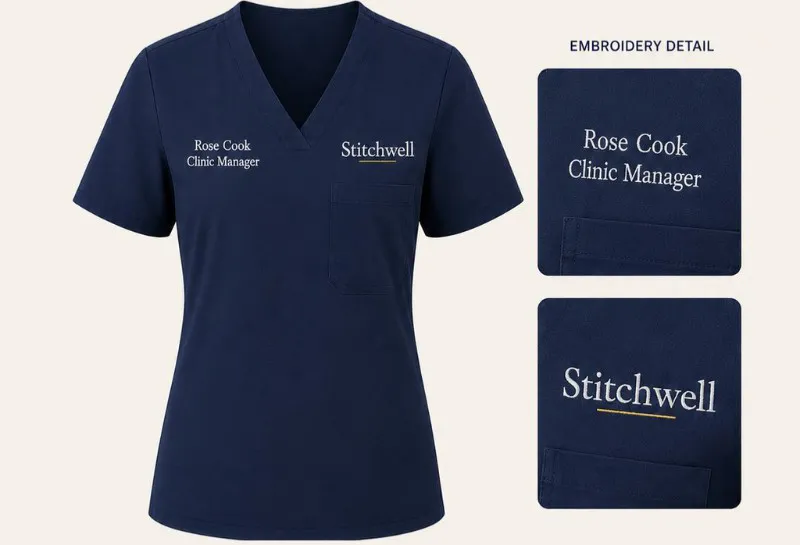
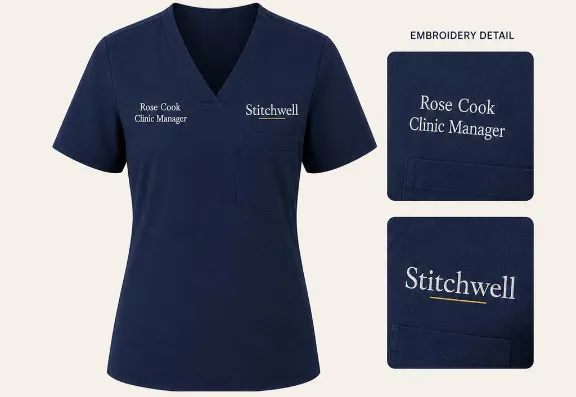
A carefully chosen scrub colour, consistent embroidery placement and clear staff identification can be enough to make the whole team feel more coordinated.
The objective is not simply to display a logo.
It is to create a team appearance that feels as though it naturally belongs in that clinic.
Presentation can influence the overall patient experience
A patient may not consciously analyse a uniform when they arrive.
They are unlikely to think about the exact embroidery position or whether everyone is wearing the same shade of Navy.
But they do experience the overall impression.
A team that looks coordinated can contribute to a sense of organisation and professionalism.
The opposite can also be true.
Different scrub colours, inconsistent embroidery, mismatched styles or ageing uniforms can make a clinic feel less considered, even if the clinical care itself is excellent.
That is why uniforms should be viewed as part of the patient-facing environment rather than simply staff clothing.
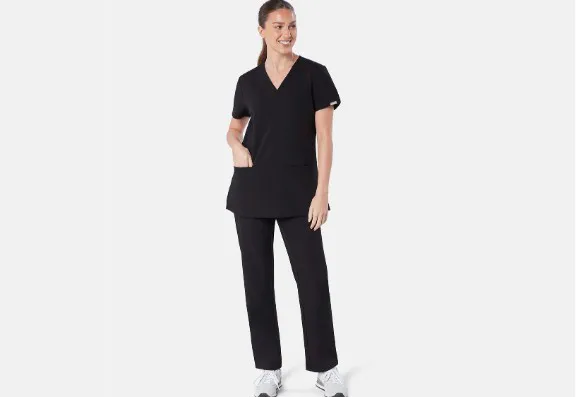
Consistency matters more than excessive branding
A common misconception is that stronger branding requires more branding.
It often does not.
Large embroidered logos, multiple lines of text or highly contrasting colours can sometimes make a uniform feel busier rather than more premium.
Consistency is usually more important.
For example, a clinic might establish:
- one or two approved scrub colours
- a consistent staff-name format
- agreed professional titles
- a standard embroidery position
- one approved logo treatment
- a small number of suitable garment styles
The result can feel far more polished than simply adding as much branding as possible.
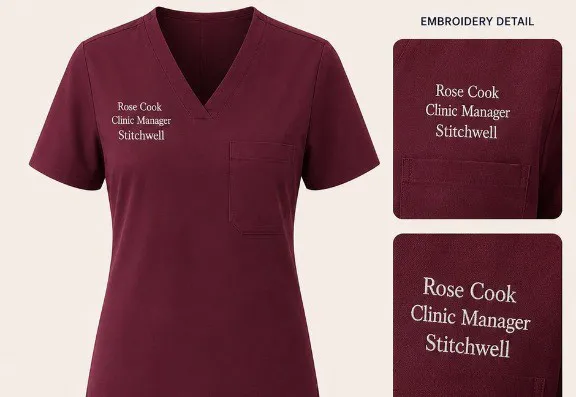
Different staff preferences do not have to mean an inconsistent team
Uniform consistency does not necessarily mean every member of staff has to wear exactly the same garment.
Different people prefer different fits.
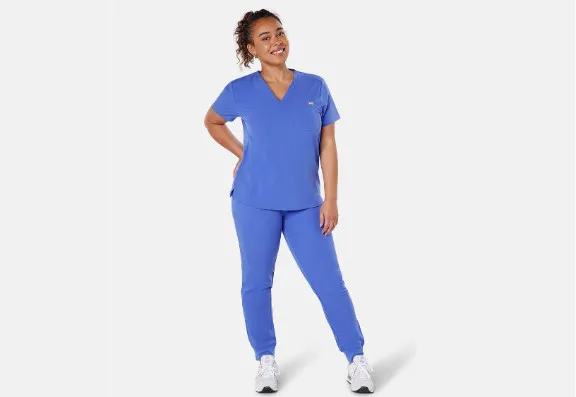
One practitioner may prefer a traditional straight-leg scrub trouser, while another may prefer a more contemporary jogger-style fit.
The important question is whether those choices still sit within the same visual system.
If colour, embroidery and overall presentation remain consistent, different garment styles can still look like one coordinated team.
This can be particularly useful in growing clinics where comfort, role and personal preference vary across staff.

The real challenge often appears when the clinic grows
A uniform decision can feel simple when a clinic has only a few team members.
The difficulty comes later.
A new practitioner joins.
Someone needs a replacement set.
A staff member changes role.
A second location opens.
One employee prefers a different fit.
Someone asks which thread colour was originally used.
The logo file cannot be found.
Nobody remembers whether names were embroidered on the left or right.
These are small issues, but they create unnecessary friction.
A clinic that establishes a clear uniform standard once can avoid having to remake those decisions each time.
That standard might include:
- approved uniform colours
- garment styles
- embroidery wording
- staff-name format
- professional titles
- embroidery placement
- thread colour
- approved clinic artwork
It does not need to become a complicated brand manual.
It simply needs to be clear enough that the next order matches the last one.
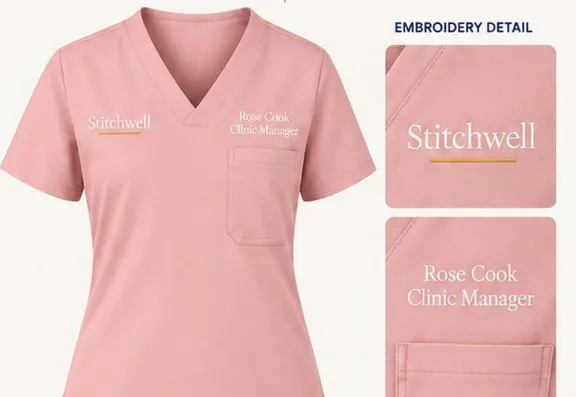
Think about the next new starter, not just today's team
One useful way to assess a clinic's uniform setup is to imagine someone joining the team six months from now.
Would you know immediately:
What colour should they wear?
Which styles can they choose from?
How should their name and title appear?
Where should the embroidery sit?
Which version of the clinic logo should be used?
Can one additional set be ordered without starting the design process again?
If the answers are already established, the clinic has moved beyond a one-off uniform purchase.
It has created a repeatable system.
That becomes increasingly valuable as the team grows.
Clinics should not have to become uniform designers
One of the difficulties with personalised workwear is that clinics can be asked to make a surprising number of design decisions before they have seen what the finished result might look like.
Choose the garment.
Choose the colour.
Upload the artwork.
Choose the embroidery position.
Choose the wording.
Choose the thread colour.
For a clinic owner or practice manager, that can turn a relatively straightforward purchase into another project.
A better starting point can be to look at the clinic itself.
What colours already define the brand?
What does the interior look like?
Is the clinic positioned as contemporary, clinical, minimal or luxury?
How prominent should the branding feel?
Once those questions are understood, several suitable uniform directions can be developed for the team to compare.
That allows the clinic to choose between professional options instead of having to design the uniform from scratch.
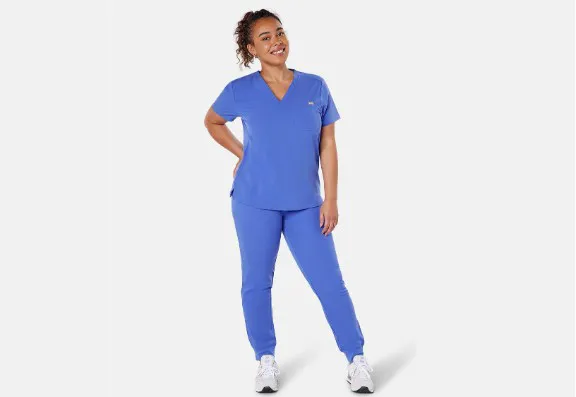
Seeing the concept before ordering can make the decision easier
This is the thinking behind Stitchwell's Clinic Uniform Concept service.
Clinics can share their branding and preferred colours, and Stitchwell creates a selection of personalised uniform concepts showing how different scrub colours, styles and embroidery treatments could work together.
The clinic does not need to decide the embroidery layout upfront.
Instead, different professional variations can be developed for the team to review before deciding whether to order.
Once the preferred setup is approved, those details can be retained for future new starters, replacements and reorders.
The aim is simple: make it easier for private clinics to create a coordinated team appearance and keep it consistent over time.
A uniform should feel like part of the clinic
The best clinic uniform is not necessarily the one with the biggest logo or the most personalisation.
It is the one that feels considered.
It fits the environment.
It complements the clinic's branding.
It helps patients identify the team.
It works for the people wearing it.
And, importantly, it can be repeated easily when the clinic changes or grows.
For private clinics investing heavily in patient experience and brand presentation, scrubs are therefore more than simply a uniform.
They are one small but highly visible part of how the clinic presents itself every day.
About Stitchwell
Stitchwell is a UK clinic-uniform supplier helping independent private healthcare practices create coordinated personalised uniforms and simpler systems for future team orders.
Through its complimentary Clinic Uniform Concept service, clinics can explore different colours, styles and embroidery options before deciding whether to order.
Consulting Room clinics can also receive free UK delivery on their first Stitchwell team order.