




UK wedding season has a shape you can set a diary by. August still takes the largest single share of bookings, but September is now the fastest-growing month, up 28% year-on-year in recent industry data (WeddingsHub analysis of 14,000 weddings) . That's a six-month runway of predictable demand most clinics aren't fully pricing in.
This piece looks at what that season actually means commercially: who's walking through the door beyond the bride, why patients are wary of unfamiliar treatments close to the day, and what a sensible, staged treatment timeline looks like.
It also covers where the money genuinely sits in a wedding offer, and what England's licensing changes mean for the treatments you choose to build one around.

A Season With a Shape: When UK Weddings Actually Happen
August Still Wins, But September Is Catching Up Fast
UK wedding season isn't evenly spread across the year. It's predictably concentrated in a handful of months. August has historically accounted for the largest single share of annual weddings, at around 18% in recent ONS-referenced data, with July close behind as the height of summer. Bridebook's 2026 Wedding Report found August was the peak month for UK weddings in 2025, with 2 in 5 UK couples marrying in summer overall.
What's shifted is the shoulder season. Analysis of 14,000 UK weddings (WeddingsHub) shows September is growing fastest, up 28% year-on-year, driven by better golden-hour photography conditions and lower venue pricing than peak summer months. For clinics, that stretches the commercial window. This isn't a six-week rush in high summer. It's a demand curve that runs from spring bookings through to fine-tuning in early autumn.
⚠️ IMPORTANT: If your wedding-season marketing only ramps up in June or July, you're missing the couples booking their September and October dates, who are often planning treatment courses from as early as the spring.
It's Not Just the Bride Who's Booking
The commercial opportunity is wider than one patient per wedding. The average UK wedding party typically run to several people beyond the couple, including bridesmaids and groomsmen. Every one of them is a potential patient with the same event, the same deadline, and often the same anxiety about how their skin will look in photographs that last a lifetime.
Add to that a cohort clinics frequently underuse in their marketing: mothers of the bride and groom. Practitioner guidance on this group is explicit that timeline planning matters just as much for them as it does for the couple, and that starting early gives the most natural, unhurried results.
That's several potential patients per wedding, not one, all converging on the same predictable calendar window.

Why Bridal Patients Avoid Aggressive Treatments Close to the Day
The Real Objection Isn't Cost, It's Risk
Ask most bridal patients what worries them about booking a new treatment close to the wedding, and cost rarely tops the list. The real concern is unpredictability. Nobody wants to discover how their skin reacts to something new with three weeks left on the countdown.
Aesthetic doctor Dr Ana Mansouri, medical director of Dr Ana the Skin Clinic in Birmingham, advises that brides should avoid stressful or unfamiliar skin interventions near the wedding to prevent redness, peeling or breakouts. Her recommendation instead is to focus on hydration, a proven skincare routine, and gentler professional treatments.
This Is Where Familiarity Beats Novelty
The practical result is a two-speed booking pattern. Patients are far more open to trying something new when there's still months of runway to judge the results and recover from any reaction. As the day approaches, they retreat to what's predictable, calm, and well-tolerated, even if that means turning down a treatment they'd otherwise be curious about.
⚠️ IMPORTANT: A treatment with a well-documented, pain-free tolerability profile has a genuine advantage here. It's one of the few categories patients will still consider booking inside that final, risk-averse window.

The Bridal Cohort: Most Clinics Only Half-Market
Beyond the Bride: A Wider, Underused Patient Base
Most wedding-season marketing speaks to one person: the bride. That's understandable, but it leaves a meaningful commercial gap. As covered above, the average UK wedding party runs to around 10 people, and every one of them is facing the same camera, the same date, and often the same quiet pressure to look their best.
Bridesmaids and groomsmen are an obvious extension. Less obvious, and more consistently overlooked in clinic marketing, is the mother of the bride or groom.
Mothers of the Bride Plan Differently, and Earlier
Practitioner guidance aimed specifically at this group treats it as a distinct planning journey in its own right, not an afterthought to the bride's. The advice is to start early and progress gradually, whether the wedding is a year away or a few months out, because collagen production and visible skin improvement don't happen overnight.
This cohort tends to be more established clinic patients already, often with existing relationships and a clearer sense of what they want. A wedding date gives you a natural, low-friction reason to re-engage them with a fresh, staged offer, rather than waiting for them to ask.
Building One Offer That Works for Every Guest of Honour
The commercial logic here isn't to create entirely separate campaigns for each group. It's to build one flexible, staged treatment pathway and message it so each audience recognises themselves in it, whether that's a 25-year-old bridesmaid or a 55-year-old mother of the groom.
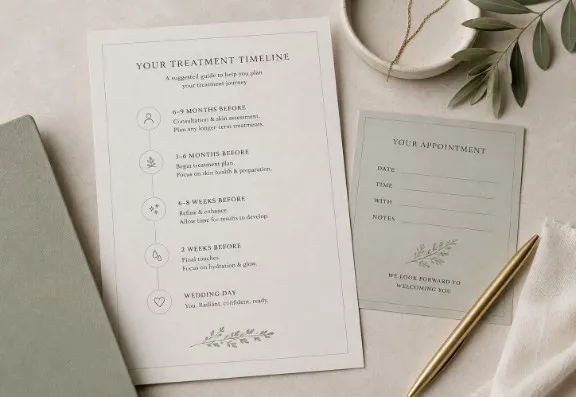
What a Sensible Wedding Treatment Timeline Actually Looks Like
Skin Doesn't Improve on Demand
The single most consistent piece of advice across UK bridal aesthetic guidance is this: start earlier than patients think they need to. Dr Richard Devine, aesthetic doctor at Cornerstone Clinic, notes that skin works in cycles, and brides should ideally begin their skincare journey six to twelve months in advance, particularly if they're dealing with concerns like acne, pigmentation or texture irregularities.
That's not marketing spin. Collagen remodelling and cumulative treatment benefits genuinely take months, not weeks, which is exactly why a rushed, last-minute booking rarely delivers what a patient is hoping for.
The Shape of a Typical Bridal Course
UK bridal protocols tend to follow a recognisable four-stage pattern, even when the specific treatments differ between clinics.
| Timing before wedding | Typical focus | Why this stage matters |
|---|---|---|
| 6-12 months | Consultation, skin analysis, course begins | Time to address underlying concerns (acne, pigmentation, texture) before working on finishing touches |
| 3-4 months | Core course treatments | Cumulative, evidence-backed improvement with time to judge and adjust results |
| 6-8 weeks | Final course session | Last point for anything with meaningful recovery time |
| 2 weeks to 48 hours | Light, familiar top-up only | Hydration and gentle, well-tolerated treatments only, nothing new or untested |
Why This Structure Protects Both the Patient and the Clinic
⚠️ IMPORTANT: The final two-to-four-week window is where "pain-free" and "predictable" stop being nice-to-haves and become the deciding factor in what a bridal patient will actually book.
A staged course also gives the clinic several natural touchpoints to demonstrate value, check progress photographs, and have a genuine conversation about what's working, rather than a single transactional appointment.

Where the Revenue Actually Sits
The Pricing Spread Already Tells You Something
UK clinics aren't guessing at bridal pricing; there's already a visible market to benchmark against. One UK skin clinic's published wedding packages (theskingym.co.uk) range from a three-month, two-treatment plan at £180 through to a twelve-month, ten-treatment plan at £690. At the more medical end, London-based Dr David Jack Clinics (via a Country & Town House feature, countryandtownhouse.com) prices a course of three medical-grade facials from £1,250.
That's a wide spread, and it tells you the market will support both accessible entry-level courses and higher-value medical courses, provided the staging and communication around them is right.
Courses Beat One-Off Bookings, Commercially and Clinically
⚠️ IMPORTANT: Every package referenced above is structured as a multi-visit course, not a single appointment. That's not incidental. It reflects both what the skin needs to show meaningful change, and what supports predictable, front-loaded clinic revenue per patient.
A staged wedding course also creates a natural upsell path. A patient who books a 3-month plan for texture concerns is a reasonable candidate for a top-up maintenance visit afterwards, or for the wider wedding-party offer covered earlier in this piece.
What This Means for a Wedding-Season Offer
The commercial opportunity isn't really about competing on price at the bottom of that range. It's about clearly communicating value across a defined timeline, so a patient booking in April for a September wedding understands exactly what they're getting, and when.

What England's Licensing Changes Mean for a Wedding Offer
The Direction of Travel Is Clear, Even If the Detail Isn't Finished
Any clinic building a bridal offer around a specific treatment now needs to factor in the direction of England's regulatory framework. Section 180 of the Health and Care Act 2022 enables the government to establish a licensing scheme for non-surgical cosmetic procedures in England and Wales. The government's consultation response, published in August 2025, sets out how the new scheme will be implemented.
The proposed model places procedures into red, amber, or green categories according to risk, with green procedures that can be carried out by any licensed practitioner meeting agreed standards. Early 2026 is set to bring further government consultation specifically on the highest-risk, red-tier procedures, with regulatory rollout, including licensing applications and inspections, expected across 2026 to 2027.
Why This Matters for a Seasonal Offer Specifically
⚠️ IMPORTANT: A wedding-season offer built around a lower-risk, well-tolerated, evidence-backed treatment is better insulated against this rollout than one built around procedures likely to sit in the amber or red tiers.
This isn't just a compliance footnote. As the scheme moves from consultation to enforcement, patients and referring practitioners are likely to become more attentive to where a given treatment falls within that risk banding, particularly for something as reputation-sensitive as wedding photographs.
A Practical Takeaway, Not a Legal One
None of this is a substitute for your own regulatory advice as the scheme finalises. But it's a reasonable planning assumption: treatments with a longer, calmer safety record and gentler risk profile are a more durable foundation for a seasonal offer than something that might face tighter restrictions mid-rollout.
Next Steps
Wedding season gives clinics something genuinely rare: a predictable, recurring commercial window with a built-in deadline, a wider patient base than most marketing currently reaches, and a clear behavioural pattern around what patients will and won't book close to the day. Clinics that plan for this properly, rather than reacting in June, are best placed to make the most of it.
Pain-free tolerability and a documented safety profile matter more here than almost anywhere else in the treatment calendar, particularly as England's licensing framework continues to take shape. If you're reviewing what sits in your wedding-season offer, triple-frequency ultrasound technology such as LDM Triple is worth a look as an option for building a course-based, evidence-backed pathway.
You can find more detail on the LDM Triple and why you should think about adding it to your clinic on our LDM Triple Information Page.
Alternatively, email us at admin@consultingroom.com with LDM Triple in the subject line, and we will send you full details.