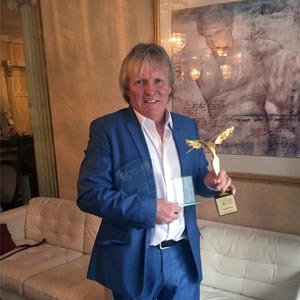
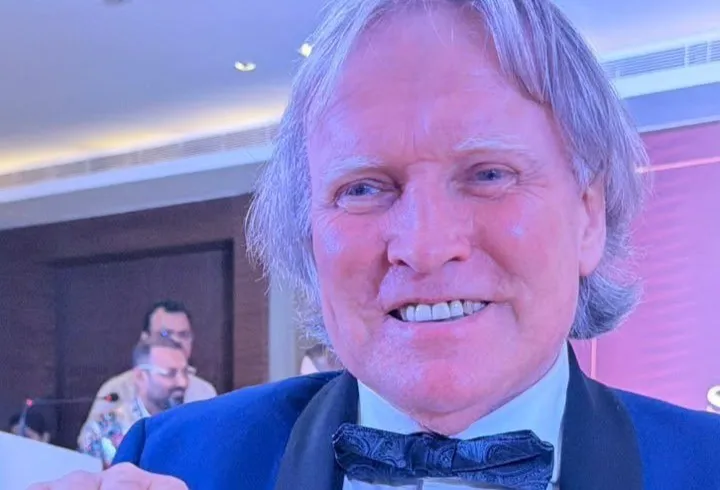


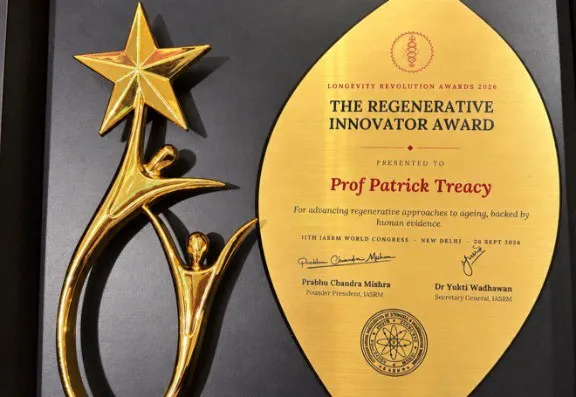
Irish physician and scientist Professor Patrick Treacy has received an international innovation award at the 11th IASRM World Congress – Longevity Revolution 2026 in New Delhi, recognising his pioneering contributions to regenerative medicine, including platelet-rich plasma, stem-cell approaches and photobiomodulation.
Treacy has an academic background spanning both medicine and basic science. He graduated in medicine from the Royal College of Surgeons in Ireland (RCSI) and also holds an honours degree in Biochemistry from Queen’s University Belfast (QUB), a combination that has influenced his longstanding interest in translating cellular biology and biochemical signalling into clinical regenerative medicine.
His work has included the early clinical application of platelet-rich plasma (PRP) and platelet-derived growth factors, stem-cell and regenerative approaches, and red-light photobiomodulation (PBM) for tissue repair, skin rejuvenation and hair restoration. More recently, this work has extended into cellular signalling, inflammation, mitochondrial function and the biological pathways associated with ageing.
The New Delhi recognition follows the World Regenerative Medicine Innovation Award, presented to Treacy at the World Scientific Conference at King’s College, Cambridge, in August 2025. That award recognised his contributions to non-surgical hair restoration and the treatment of burns and vascular occlusions using regenerative therapies involving PRP, stem-cell approaches and photobiomodulation.
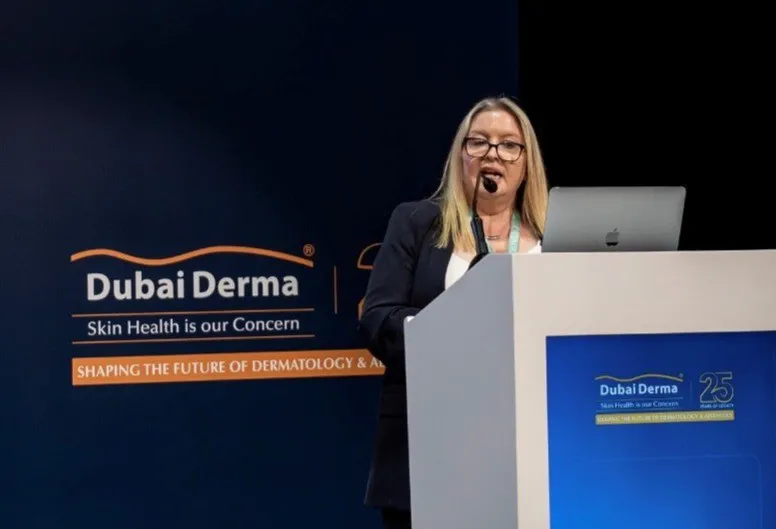
At the 2026 IASRM World Congress, Treacy delivered a keynote address entitled “Pathways of Ageing and Human Longevity,” examining genomic, epigenetic, mitochondrial, inflammatory and regenerative mechanisms involved in biological ageing.
His presentation also emphasised an increasingly important distinction within longevity medicine: evidence of an effect on a molecular pathway or biomarker is not necessarily evidence of improved human healthspan or lifespan. Treacy advocated a clinical evidence pathway progressing from biomarkers and biological-age measurements through tissue function and healthspan, with lifespan representing the ultimate endpoint.
The award reflects a broader evolution within regenerative medicine. Techniques once considered primarily in the context of aesthetic, reconstructive or wound-healing medicine are increasingly being investigated in relation to cellular communication, senescence, chronic inflammation, mitochondrial biology and the age-associated decline in regenerative capacity.
Treacy has described this progression as a move away from simply attempting to replace or repair damaged tissue towards understanding the biological signals and tissue microenvironment that determine whether effective regeneration can occur.
His work with PRP, stem-cell biology and photobiomodulation over several decades has followed this principle: combining biological signalling with attempts to create a cellular environment more conducive to repair and regeneration.
The 2025 Cambridge award and the latest recognition in New Delhi represent successive international acknowledgements of this work and its progression from early regenerative therapies towards the emerging interface between regenerative medicine and longevity science.
Professor Patrick Treacy, MB BCh, BSc (Hons), H.Dip Dermatology, MICGP, FACSAM (Hon), is a graduate of the Royal College of Surgeons in Ireland and holds a BSc (Hons) in Biochemistry from Queen’s University Belfast
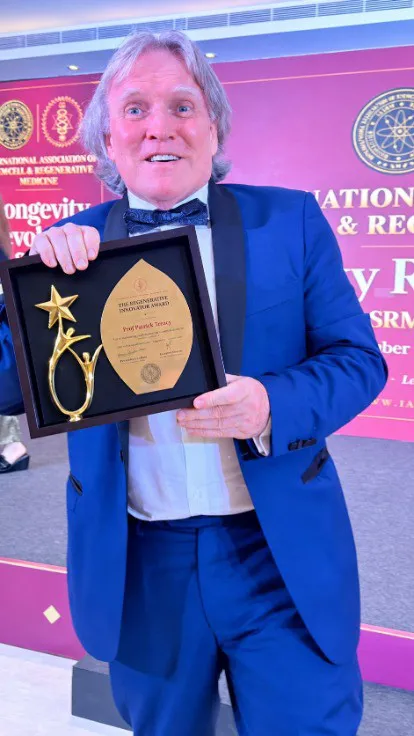 Dr Patrick Treacy