
Treat early, scar less?
This educational article explores whether earlier control of inflammatory acne could play a role in reducing the longer-term risk of scarring and considers where S430 nm 3D IPL may fit within current acne management. Drawing on established clinical guidance alongside a recent dermatologist-led four-patient case series using the Alpha System S-430, it examines the relationship between inflammation and scarring, the proposed mechanism of S430 nm 3D IPL, patient selection, treatment approach and observed clinical outcomes. Importantly, the article takes a balanced approach to the evidence, recognising the limitations of a small uncontrolled case series and making clear that the findings do not establish scar prevention or superiority over existing treatments. The article is structured for CPD, with defined learning objectives, key clinical takeaways, references and assessment questions.
For many patients with acne, clearing the active disease isn’t the end of the story.
Redness and pigmentation can remain long after the lesions have settled. For some, the lasting legacy is scarring – and that can be far harder to treat than the acne that caused it.
Which raises a simple question: are we sometimes waiting too long to get inflammation under control?
Acne vulgaris is one of the most common conditions seen in dermatology and aesthetic practice. It may begin in adolescence, but it can persist well into adulthood. Beyond the active lesions, patients can be left with post-inflammatory erythema, pigmentation and permanent scarring. The psychological impact can also be significant.¹,²
We tend to judge acne treatment by what we can see improving: fewer papules, fewer pustules, clearer skin. But there is another question worth asking.
What is happening while the inflammation is still there?
Why inflammation matters
Acne scarring develops through the inflammatory and healing response within the skin. Once permanent structural change has occurred, treatment becomes more difficult. Different scar types can occur together, several treatment approaches may be needed, and complete correction isn’t always possible.
So, preventing scars where we can is clearly better than trying to correct them later. That doesn’t mean every inflamed acne lesion is going to scar. It doesn’t mean clearing acne quickly guarantees that scarring won’t happen either. But the duration of acne matters.
NICE specifically advises clinicians to take into account that the risk of scarring increases with both the severity and duration of acne when choosing treatment.² Treatment of ongoing acne is also recommended as part of the approach to preventing further scarring.
For patients who are already beginning to scar, or whose inflammatory acne is persisting, that feels particularly important. Perhaps, then, severity isn’t the only question we should be asking when somebody presents with inflammatory acne.
Duration matters too.
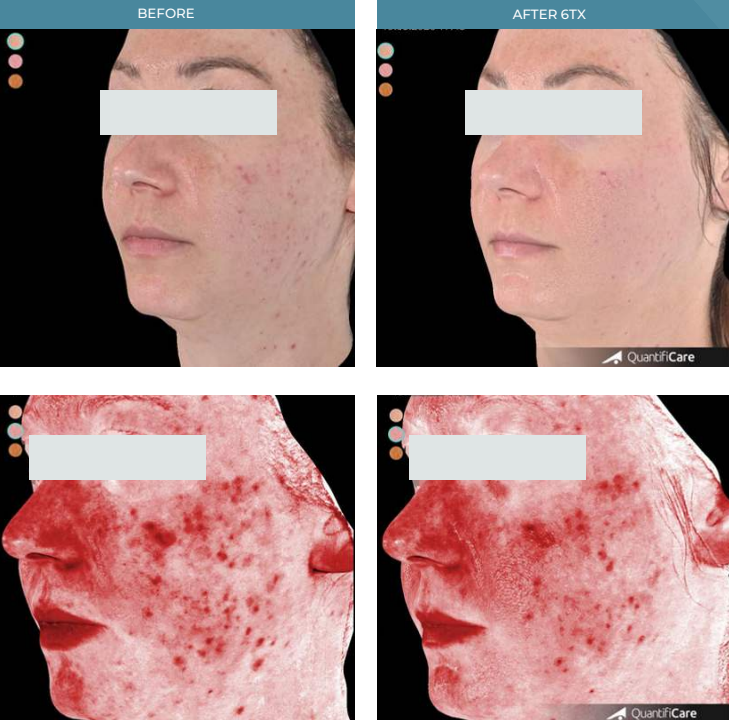
Before and after six weekly treatments with S430 nm 3D IPL monotherapy. Images courtesy of Dr Bartomiej Sobolewski, Poland.
Where does light-based treatment fit?
There is no shortage of treatments for acne. Topical retinoids, benzoyl peroxide, antibiotics, hormonal therapies and oral isotretinoin all have established roles. Alongside these sit chemical peels, photodynamic therapy and a range of laser and light-based treatments.¹,²
These aren’t interchangeable treatments, and light-based technology shouldn’t be presented as a replacement for medical management. Oral isotretinoin, for example, remains an important treatment for severe forms of acne where standard therapies have been adequately tried.²
There are, however, reasons to look beyond medication alone. Antibiotic use brings the familiar issue of antimicrobial resistance. Daily treatment relies on adherence. Systemic treatments may involve side effects and monitoring, while isotretinoin requires particular precautions and appropriate clinical oversight.¹,²
Some patients may also prefer to avoid systemic medication where there is another clinically appropriate option. This is where light-based treatment becomes interesting. Not because it replaces everything that has gone before, but because it may give clinicians another way of approaching active inflammatory disease.
The evidence needs to be kept in perspective. NICE currently describes the evidence for physical treatments in mild-to-moderate acne as very limited and has called for further research into treatments including light devices.² That uncertainty is important. It also makes emerging clinical evidence worth examining.
Why 430 nm?
The science behind S430 nm 3D IPL in acne starts with Cutibacterium acnes. C. acnes produces naturally occurring porphyrins. When these absorb light at an appropriate wavelength, reactive oxygen species are generated. These can cause localised bacterial destruction through a photochemical rather than antibiotic mechanism
There may be more going on than bacterial reduction alone. Thermal and tissue responses associated with IPL have also been proposed to have anti-inflammatory effects and to influence sebaceous activity and the environment within the follicle.¹,³
There is, then, a rationale for investigating S430 nm 3D IPL in inflammatory acne. But in practice, another part of the story may matter just as much.
How quickly can you reduce the inflammation?
If meaningful improvement can be achieved over a relatively short course of treatment, light-based therapy may have a useful role in the management of appropriately selected patients. Exactly where that role should sit is still open to debate.
Six weeks of treatment
A recent prospective observational case series from Sobolewscy Clinic in Wrocaw, Poland gives us an interesting real-world example.
Four female patients with inflammatory acne were treated under the supervision of dermatologist Dr Bartomiej Sobolewski. Each underwent a dermatological assessment before treatment, including medical history, acne severity, medication review, possible contraindications and screening for photosensitising agents.
The patients were treated once a week for six weeks using the Alpha System with its S-430 3D IPL applicator. The S430 nm 3D IPL was used as monotherapy, without systemic acne medication alongside it during the study. Before each treatment, skin was assessed using a digital melanin meter. This provided an objective measurement to help guide treatment parameters rather than relying on Fitzpatrick skin type alone.
Treatment involved an initial pass across the treatment area, followed by more targeted treatment of active inflammatory lesions. First-pass fluences ranged from 12–14 J/cm², rising to 12–16 J/cm² for the targeted second pass.¹
Importantly, the results weren’t judged from ordinary before-and-after photographs alone. Standardised clinical photography was supported by QuantifiCare 3D imaging, allowing changes in lesion distribution and volume, erythema and skin-surface characteristics to be followed through treatment.
What changed?
After six weekly treatments, all four patients showed an improvement in inflammatory acne. Estimated inflammatory lesion counts across the group ranged from approximately 25–120 at baseline. At final assessment, this had fallen to approximately 10–55 lesions.
The changes were also seen in the standardised photographs and QuantifiCare imaging, with reductions in inflammatory lesion burden and facial erythema.¹ There were no documented treatment-related cases of blistering, erosion, pigmentary alteration, scarring or infection during the study period. All four patients completed the planned six-treatment course.¹
Six weeks is a relatively short window. That’s what makes these cases interesting. The authors note that oral antibiotic therapy may take 8–12 weeks before meaningful improvement can be adequately assessed, while isotretinoin treatment typically continues for considerably longer. In these four patients, visible change was documented after six weeks of IPL treatment.¹ NICE similarly advises patients that positive effects from established acne treatments can take around six to eight weeks to become noticeable.²
But this wasn’t a comparison study. We can’t say that six weeks of IPL was more effective than six weeks of another treatment because that wasn’t tested.
What we can say is that the inflammatory burden reduced over a relatively short treatment period. When we’re thinking about the length of time a patient spends with active inflammatory disease, that is worth paying attention to.
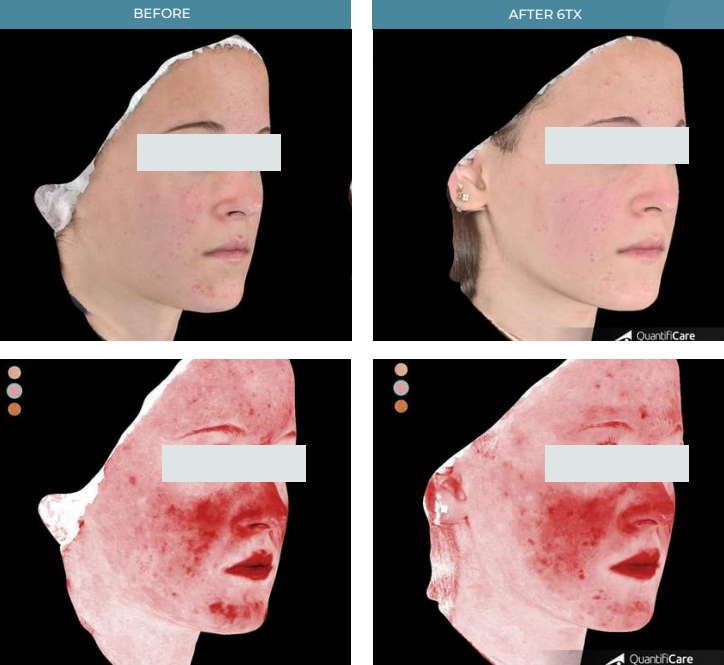
Clinical photography and QuantifiCare assessment before and after six weekly treatments.
Four patients aren’t proof
This matters. The results are encouraging, but this was a case series involving four patients. There was no control group. There was no randomisation and no direct comparison with antibiotics, isotretinoin or another energy-based treatment. And there wasn’t long-term follow-up designed to establish what happened to these patients’ subsequent risk of scarring.
So, this study doesn’t prove that S430 nm 3D IPL prevents acne scars. It doesn’t prove that IPL is better than established acne treatments. And we shouldn’t pretend that it does. What it shows is more straightforward – and still worthwhile.
Four patients with inflammatory acne received six weekly treatments with S430 nm 3D IPL. All four showed a reduction in inflammatory acne, with changes documented through clinical photography and 3D imaging. No treatment-related adverse events were recorded during the treatment period.¹ That’s enough to make the results interesting. It’s also enough to make the next question worth asking.
If we can bring inflammatory acne under control sooner, could we reduce some of the damage that comes afterwards?
At the moment, we don’t have the evidence to answer that specifically for S430 nm 3D IPL.
Larger controlled studies, more patients and longer follow-up would be needed to determine where the treatment should sit within acne management and whether earlier reduction of inflammation translates into a measurable reduction in subsequent scarring. That need for further evidence isn’t unique to this study. NICE has also identified physical treatments, including light devices and IPL, as an area where better-quality research is needed.
So, should we treat earlier?
Not necessarily with IPL. Not necessarily in every patient. But perhaps we should think more seriously about time. How long has the inflammation been present? Is it getting worse? Is the patient beginning to scar? Is the current treatment working? And if it isn’t, what should happen next?
Current NICE guidance already reflects some of this thinking. The risk of scarring increases with the severity and duration of acne, and referral should be considered where acne is leading to scarring or persistent pigmentary change.²
For IPL, proper patient selection remains essential. Acne severity and type, skin characteristics, medication, recent UV exposure and photosensitising agents all need to be considered. Eye protection, informed consent and individual parameter selection are basic requirements.¹
S430 nm 3D IPL won’t be right for every patient. Neither should it be positioned as a replacement for established acne therapies. But this small case series gives us a reason to keep investigating its role. Because perhaps the question shouldn’t always be:
How do we treat the scars this acne might leave behind?
Perhaps, where we can, we should be asking it earlier:
What can we do now to give those scars less chance to develop in the first place?
Key points
- Acne can leave lasting erythema, pigmentation and permanent scarring, with both the severity and duration of disease contributing to scar risk.
- Once acne scars are established, they can be difficult to manage, making effective control of ongoing acne important.
S430 nm 3D IPL interacts with porphyrins produced by C. acnes, generating reactive oxygen species through a photochemical mechanism. - In this four-patient case series, six weekly S430 nm 3D IPL treatments were associated with reductions in inflammatory acne and facial erythema.
- No treatment-related adverse events or treatment discontinuations were documented during the study period.
- The study does not establish that S430 nm 3D IPL prevents acne scarring or is superior to established acne treatments.
- Current evidence for light-based physical treatments remains limited, and larger controlled studies with longer follow-up are needed.