Beyond injectables
When I first started working in aesthetics, like many practitioners, a significant part of my practice revolved around injectable treatments.
Dermal fillers and botulinum toxin remain incredibly valuable tools, but as my experience developed, I became increasingly aware of something very simple: not every patient who walks into an aesthetic clinic needs an injectable.
In fact, many of the concerns patients were bringing to me such as fine lines, uneven texture, enlarged pores, pigmentation, acne scarring and declining skin quality , could not be adequately addressed with dermal filler or botulinum toxin alone.
This was one of the reasons I started looking more seriously at energy-based devices and, eventually, introduced LaserMe by Neauvia into my practice.
What I did not fully appreciate at the time was how much this would change not only the treatments I could offer, but also the way I approached consultations and, ultimately, the way I structured my business.

What is LaserMe?
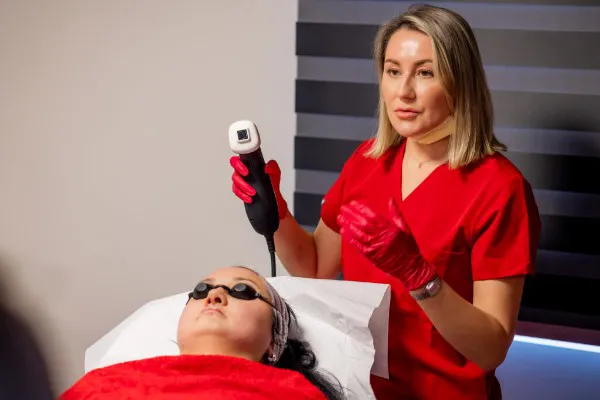
LaserMe is a non-ablative fractional laser designed for skin resurfacing and regeneration.
Fractional technology works by delivering controlled columns of thermal energy into the skin while leaving areas of surrounding tissue untreated. This fractional approach is important because the untreated tissue supports the healing response, allowing us to stimulate dermal remodelling without creating the degree of surface injury associated with more aggressive ablative resurfacing.
Clinically, this makes LaserMe useful when treating concerns including: fine lines and wrinkles, uneven skin texture, enlarged pores, acne scarring, pigmentation and photodamage, overall deterioration in skin quality. For me, however, the important point is not simply the list of indications. It is where the technology fits within a treatment plan.
Moving from “what treatment do you want?” to “what does your skin need?”
One of the biggest changes LaserMe brought to my practice was a shift in the way I approached consultations. Patients frequently arrive having already decided what they need. “I think I need filler.” “I want something for these lines.” “My friend had this treatment and I want the same.”
But when we assess the patient properly, the treatment they are asking for is not always the treatment that will best address what is bothering them. A patient may describe her/ his face as looking tired and assume she/he has lost volume. On assessment, however, part of what she/he is seeing may be poor skin quality, photodamage, textural change and fine lines. Adding volume cannot correct all of those things.
Having a fractional laser within my practice therefore gave me another therapeutic option. Instead of trying to solve every sign of ageing with an injectable, I could start separating volume, movement, skin quality and tissue laxity and treating each component appropriately. That has probably been one of the most important developments in my clinical practice.
Why combination treatment became important to me
LaserMe also reinforced my belief that aesthetic medicine works best when we stop thinking about treatments in isolation. Facial ageing is multifactorial. We have changes in bone, fat compartments, ligaments, muscle activity and skin. Within the skin itself we see alterations in collagen, elastin, pigmentation, hydration and texture. It therefore makes little sense to expect one treatment to address everything. This is where combination therapy became increasingly important in my practice.
For example, I frequently combine LaserMe with Neauvia Hydro Deluxe, a skin booster containing hyaluronic acid, calcium hydroxyapatite, glycine and L-proline. The treatments are doing different jobs. LaserMe creates a controlled thermal stimulus intended to encourage tissue remodelling, while the injectable component is used to support hydration and skin quality. Depending on the patient’s presentation, LaserMe can also sit within a wider programme involving technologies such as Zaffiro, medical skincare or carefully selected injectable treatments. The objective is not to perform more procedures on every patient. It is to understand which biological problem we are trying to influence with each intervention. That distinction is important.
Treating areas I previously found difficult
Another practical advantage has been the ability to address areas where injectable treatments alone can be limited. The neck is a good example. Patients frequently present concerned about horizontal neck lines, crepey skin, texture and early laxity. Simply placing filler into individual lines does not necessarily address the overall quality of the tissue. In these patients, I can look at the neck much more comprehensively and consider resurfacing, collagen stimulation, hydration and tightening depending on what I see clinically.
The same principle applies to acne scarring. Rather than approaching an acne-scar patient with a single procedure, I can assess the scar morphology, pigmentation, background inflammation and overall skin quality and create a staged programme.
Importantly, this also means recognising when not to laser. Active inflammatory disease, an impaired skin barrier, inappropriate skin preparation or unsuitable patient selection can increase the risk of complications. Energy-based devices require the same level of medical assessment, consent and clinical judgement as injectable treatments. Owning a device should never become a reason to use it.
What did LaserMe do for my business?
The business impact was something I noticed gradually. Before introducing device-based treatments, a large proportion of my revenue was connected to individual injectable appointments. The difficulty with this model is that many injectable treatments have relatively long treatment intervals. A patient may attend for botulinum toxin several times per year or filler considerably less frequently.
Skin treatments create a different patient journey. Fractional laser treatments are often planned as a course, followed by maintenance according to the patient’s indication and response. That creates continuity. Instead of seeing someone for one isolated procedure, I may now work with that patient over several months. From a business perspective, this has helped create more predictable treatment pathways. But clinically, I think the bigger benefit is that I get to know the patient’s skin properly.
I see how they respond. I can adjust parameters and treatment intervals. I can introduce or modify their home skincare. And I can assess objectively whether what we are doing is actually working. The relationship becomes less transactional and much more longitudinal.
From selling treatments to building treatment plans
If I had to summarise the biggest impact LaserMe has had on my practice, it would actually have very little to do with the laser itself. It changed my mindset. I moved further away from treating individual features and towards treating the patient as a whole. Injectables remain part of my practice. Devices remain part of my practice. Medical skincare remains part of my practice. But none of them is the complete answer. The value comes from understanding when to use each one, when to combine them and, equally importantly, when not to treat at all. From a business perspective, this approach has helped me build longer-term patient journeys, diversify my revenue beyond injectables and attract a broader patient demographic.
From a clinical perspective, it has given me another tool to address something I increasingly believe should be central to modern aesthetic medicine: not simply changing how a face looks, but improving the quality of the tissue we are treating.
And for me, that has been the real value of bringing LaserMe into my practice.
More information please visit:
https://www.consultingroom.com/industry/campaign/laserme